Showing posts with label Alabama Governor. Show all posts

Wednesday, August 28, 2019

ALDOT withheld critical information during public review and AFTER the Record of Decision.


Monday night's publication of the Alabama Department of Transportation's reasoning for recommending replacement of the Bayway (PDF) as part of the Mobile River Bridge & Bayway Project came AFTER the Record of Decision (ROD) was signed on August 15, 2019.

It came AFTER the ROD was announced in the Federal Register.

ALDOT claimed in its "Media Response and Project Information – Bayway Height" that:
To comply with Federal regulations, ALDOT determined replacing the Bayway above the 100-year storm surge elevation is in the best interest for the safety of traveling public and is the most cost-effective solution.
As we saw yesterday, this is certainly not the most cost-effective solution. That solution is widening and retrofitting the existing Bayway and providing for its complete replacement 40 years from now (or whenever construction is complete).

The Bayway Alternatives Analysis Matrix that was released with the Media Response fails to reflect the discounted present value of future replacement and is based on the ridiculous assumption that widening and retrofitting the Bayway will not extend its useful life.

The key takeaway is not that the August 26 documents are incorrect. It's that ALDOT didn't release them until the ROD was signed and delivered, an action which completes the NEPA process for the project.

If this information had been known prior to the publication of the Final SEIS and the ROD, members of the public, the news media and local elected officials could have done something with it.

Instead, ALDOT held a number of listening sessions and meetings with local officials. They never told those officials what the regulations really said. They never shared an alternatives analysis matrix. They never told anybody that a structure built to the 50-year standard was not only permissible, but cost-effective.

You can't use critical information you aren't told about.

Instead, Governor Kay Ivey blasted every media outlet in the state with a rambling op-ed, and called opponents' statements "misinformation."

It's not like this information wasn't asked for, either. Click (or tap) the image below:


What this silence tells me is that ALDOT had this information. ALDOT knew this information could change the course of public discussion of the project. ALDOT knew this information might then cause the agency to reevaluate alternative plans.

And ALDOT held this information until after the NEPA process was complete.

I repeatedly asked ALDOT to delay the NEPA process and re-open or extend public review and they repeatedly refused to do so. 

I leave it to my readers to speculate on the reason why.

Wednesday, August 21, 2019

UPDATED: Governor Ivey and bridge proponents suffer major setback as Transportation Tax Project is put on hold


See update below.

Make no mistake about it--Wednesday's unanimous vote to table all items related to construction of ALDOT's Transportation Tax Scheme represents a major setback.

The vote by the Mobile Metropolitan Planning Organization to approve the whole Transportation Improvement plan was quietly expected to sail through a process mandated by a federal law known as MAP-21. Succinctly, MAP-21 requires federal spending to be approved by a local transportation planning group, in this case the South Alabama Regional Planning Commission's MPO.

However, the Facebook Group Block the Mobile Bayway Toll got wind of the gravity of Wednesday's decision and quickly swung into action. MPO members (almost all of whom are locally elected officials) were deluged with comments and fervent requests to either table or remove the specific projects related to the Transportation Tax Scheme.

The MPO carefully and openly considered the merits of the public's concerns and called timeout.

The items tabled today will be held in abeyance until after Alabama Toll Road, Bridge, and Tunnel Authority holds a special meeting on October 7, 2019. ALDOT may not receive or spend any funds on the tabled items until they're approved.

First, this is a setback because this delay likely wrecks ALDOT's schedule. The three private sector contractors cannot submit their final proposals until all clearances have been received. ALDOT had planned to receive those proposals by the end of the calendar year and award a contract in early 2020. That looks unlikely.

Second, this delay also gives creative minds about six weeks to come up with different design and funding concepts for the project. It also gives ALDOT time to conduct at least a cursory coastal storm surge risk analysis on the Bayway modification vs replacement controversy.

This will force project planners to reconsider their alternatives analysis and that in turn has a likelihood of resulting in at least an addendum to the environmental documents approved on August 16. This is another schedule wrecker.

Further, this gives steadfast and well-funded bridge opponents more time to prepare their complaints and file their lawsuits against the project. Those lawsuits will happen if ALDOT and FHWA try to move this project forward as is.


So yes, Wednesday's decision was a very big deal.

Update: The implications on the project schedule were made explicit yesterday by ALDOT Director John Cooper. Cooper was in an informational meeting with area elected officials held after the MPO meeting:
ALDOT’s Transportation Director John Cooper says Mobile Metropolitan Planning Organization’s (MPO) decision to table the vote for funding and the Eastern Shore MPO's consideration to remove the project from the transportation improvement plan (TIP) stops them from requesting proposals. It's tricky because he says officials would want a final proposal first before putting it back in the TIP.
"We can't deliver on what you have asked us to do in the position you have put us in," Cooper said. "We can't bring you a final plan without it in the TIP."
Just as I said. The schedule is wrecked.

Tuesday, August 20, 2019

MOBILE RIVER BRIDGE & BAYWAY PROJECT ECONOMIC IMPACT FACT SHEET


FACT: The $2.1 billion Mobile River Bridge & Bayway Project has a benefit-cost-ratio less than 1-to-1 and will consume far more economic resources than it produces. The No-Build alternative is more favorable.[1]

FACT: In 2019 dollars, the Bridge alone will have a $6.8 million annual negative impact on the Mobile maritime industry. The economic impact to other sectors (tourism, healthcare, construction, retail trade, etc) is unknown.[2]

FACT: The economic value of storm surge risk to both the existing Bayway and the proposed new Bayway is undisclosed and unknown.[3]

FACT: The Traffic & Revenue Study improperly uses arbitrary inflation rates in its forecasts and uses a lower inflation rate for cost growth and a higher inflation rate for revenue growth, producing artificially distorted net revenues.[4]

FACT: The Africatown/Plateau Community and Downtown Mobile will face higher traffic congestion costs and increased accident risk cost from drivers avoiding the MRB&B transportation tax.[5]

FACT: Mobile and Baldwin area law enforcement and judicial administrative systems face unknown burdens and unknown costs in enforcing transportation tax payments.[6]

FACT: The project includes bicycle, pedestrian and other recreational features that serve neither the stated project purpose or need and have no identified methods of paying for themselves.[7]

FACT: A new toll is a de facto tax increase. Enforced tolls and enforced taxes are treated identically by consumers and businesses in the marketplace. Consumers seek to avoid taxes where practical and/or constrain spending elsewhere. Businesses pass the full cost to consumers through price increases and accept the risk of lost sales. The cost of everything increases.

CONCLUSION: The MRB&B Project represents a bad investment for Mobile & Baldwin Counties, the State of Alabama and the Nation.

Read the full report on the project here.


[1] Draft Environmental Impact Statement, 2014, Table 9, indexed to 2019 dollars using CPI 2012-2019.
[2] Ibid.
[3] Supplemental Draft EIS, 2019, Appendix G.
[4] I‐10 Mobile River Bridge and Bayway – Draft Traffic & Revenue Study Report, May 2018.
[5] Ibid.
[6] Alabama Senate Bill 347.
[7] Final Environmental Impact Statement and Record of Decision, 2019.


Sunday, August 18, 2019

Bridge Economics in Alabama


There are three things certain in life: Death, taxes and the determination of people to avoid both.

Yes, this is going to be a snarky post with a little good ol' smart-assery. Hey... this stuff needs to be said and I have the un-buffered medium with which to say it.

Remember: I am not opposed to tolling as a concept for financing projects with the demonstrated economic benefits needed to support it. I am opposed to projects that do not have the economic benefits that the toll seeks to monetize. Ramming infeasible projects through just because you can is a recipe for economic disaster. Bad tax policy has a bad habit of making bad things happen. Duh.

Tolling defenders claim that the toll is not a tax--you can simply use another route to make the trip. This makes about as much sense as saying sales taxes aren't taxes because you can simply choose not to eat. Or not to wear clothes. Or not to use deodorant. Or not take your anti-psychotic medication. You can choose to be hungry, naked, smelly and crazy and go tax free, right? Your choice.

Come on, folks. If the government makes you pay for the privilege of doing something, it's a tax.

From an economics perspective, a tax and a toll evoke the same response in how businesses and consumers behave in the marketplace. For consumers, the cost is a new item in their budget constraint. To the extent feasible the consumer will avoid paying it and will forego buying something else to pay what cannot be avoided. For businesses, the full tax burden will be added to the cost of the goods sold and the owners will absorb the risk of reduced sales as a result.

A toll and a tax are interchangeable in a model of any economy burdened by either.

So, henceforth this space will use the term "tax" when referring to the cost burden of this project. When you correct the terminology you change the narrative.

"Toll" is a four-letter word.

Even famous people avoid taxes. We're not famous here, but we have our ways.

Under current Alabama law, anyone aged 19 and over can buy a car without being required to simultaneously register the vehicle with the state. This is because Alabama law requires car owners to provide proof of liability insurance when registering their vehicle. Not surprisingly, cars are cheap in Alabama and they're easy to obtain. Look around -- $99 sign and drive (SAD) car dealerships are thriving from one end of the state to another. They don't care about your credit and they might not even check to make sure your driver's license is valid.

Those cars will become very popular if the Mobile River Bridge & Bayway project is built as a taxed route. No tag means no tax.

Alabama drivers are also notorious for failing to renew their vehicle registration, and part of that is because they have also failed to renew their liability insurance. For many, paying the first period's insurance premium and defaulting on the plan is part of the SAD game. But the state still has a name and address for that tag, expired or not. That tag promptly disappears.

This will also be a popular choice among commuters in Mobile and Baldwin Counties, especially among lower income folks. These are the people for whom a new $90 monthly tax has crowded the budget constraint.  Do they renew registration and insurance? Do they look for work in a place with no transportation tax? Do they take a look-see at what others are doing to avoid the tax?

We can also reasonably expect the emergence of a black market dealing in fake or stolen license tags and stolen or hacked electronic transponders. Craigslist and similar sites will surely have any of these on offer.

Tough choices will be made by consumers and businesses and none of them will be beneficial to the revenues of the tax collector.

The ALDOT/FHWA team has decreed that the number of invalid tags using their project will amount to about 5%, and that average weekday traffic on the 2030 established and taxed project will be about 70,000 vehicles. Doing some math gives us approximately 3,500 tax violators per weekday.

If we conservatively assume 48 4.5 day work weeks, we could see 756,000 accused tax cheats every year.

Goat Hill has a plan for all these tax cheats. Alabama Senate Bill 347 flew through the 2019 legislative session, giving the state the power to assess administrative fees on unpaid tax violators; to non-renew vehicle registration of vehicles for failure to pay a tax violation and assessed administrative fees; and to further provide reciprocal agreements with other states or jurisdictions that have also pursued the madness of directly taxing drivers.

What percentage of the 756,000 tax cheats will bite the bullet and pay up? Half, maybe?

That leaves the other half as unrepentant tax cheats in the eyes of the pointy heads in Monkeytown. They are coming after you, you rebellious Gulf Coastians.

This is going to be our administrative and judicial nightmare:
  • There won't be enough local yokels or state troopers on the road to pull over and either ticket or tow the tax dodgers. 
  • There won't be enough room in the impound lots for tax dodging vehicles to be held pending resolution. Towing companies will feast on the carnage.
  • Traffic court dockets will be jam packed with transportation tax dodgers. Our municipal and district court systems will have much less docket space for the real public safety threats like DUIs, reckless drivers, scene leavers and drug traffickers. Real bad guys will get away.
  • What will be done with the people who are on their third or fourth tax cheat citation? Jail them?
  • Vehicle registrations will plummet while $99 SAD auto sales will be steady or climbing.
  • There will be thousands more unregistered and uninsured vehicles on our roadways every year. This is a serious threat to the personal and economic well-being of every safe driver on the road.
  • People will inevitably lose their cars and will also lose their jobs. Another $99 SAD?
  • Traffic on the tax-free route will skyrocket and traffic on the taxed route will drop. 
  • The Africatown Community will be swamped with tax-avoiding but otherwise decent and courteous drivers on the tax free route.
  • The taxed route operator's revenues will suffer, leading to an inevitable increase in the tax rate. The increased tax rate will then drive even more consumers to either constrain their other spending or (more likely) join the growing hordes of tax cheats.
  • The economic output of Mobile and Baldwin Counties will drop. Home prices will fall. Sales tax collections will contract.
  • The Alabama Gulf Coast will be less competitive in recruiting new business. Who wants to locate in an area with depressed personal income, slumping housing prices and higher-than-average unemployment?
This has a very good chance to be the economic picture of the Alabama Gulf Coast in about 10 years, if the MRB&B project is built as planned. 

It doesn't have to be this way. If the ALDOT and FHWA team go back to the drawing board, they can develop an economically feasible plan.  That plan would likely follow the lead of the 2014 EIS, which never recommended taxing the plan's users. That plan would also seriously consider the economic effects of hurricane and storm damage risk. Don't hide behind a leeway-laden standards recommendation. Don't fearfully try to design away 100% of the risk posed by an improbable storm event occurring with an unlikely sea level rise. Instead, compute the expected annual risk of a wide array of alternatives and seek the plan that best balances cost with risk reduction benefits.

The only other alternative is the no-build alternative. The people of the Alabama Gulf Coast are used to storms and hurricanes. We're used to the occasional weekday traffic jams on the Bayway. We know better than to try making an optional Bayway trip on check-in days during the summer tourist season. 

We're ok with it as is.

Saturday, August 17, 2019

ALDOT and FHWA probably violated their own guidance by Doc Dropping environmental clearance


Pardon me while I go policy wonk on you.

On August 16, 2019 ALDOT and FHWA published a combined Final Environmental Impact Statement and Record of Decision (FEIS/ROD) on the proposed Mobile River Bridge and Bayway. This surprised a lot of people, who believed that the changes made between the 2014 EIS and the May 2019 Supplemental are significant enough to make them follow standard NEPA procedure and wait 30 days between publishing the FEIS and executing the ROD.

FHWA guidance allows for "accelerated decisionmaking," but under some fairly strict limitations.

Section 1319(b) "Single Final EIS and ROD Document"
Section 1319(b) directs the lead agency, to the maximum extent practicable, to expeditiously develop a single document that consists of an FEIS and ROD, unless certain conditions exist. Traditionally, and in accordance with the CEQ Regulations (40 CFR 1506.10(b)(2)), FEIS and ROD documents are issued as separate documents with a minimum 30-day period between the FEIS and ROD. Section 1319(b) directs the lead agency, to the maximum extent practicable, to combine the FEIS and ROD into a single document unless:
  1. The FEIS makes substantial changes to the proposed action that are relevant to environmental or safety concerns; or
  2. There are significant new circumstances or information relevant to environmental concerns and that bear on the proposed action or the impacts of the proposed action.

Could demolishing approximately 7 miles of 4-lane Bayway and replacing it with roughly the same length of 8-lane Bayway be a substantial change to the proposed action? One might think that the approximate $1 billion cost increase of doing so is "significant new information."

Could completely changing the proposed action from a toll-free bridge to a toll-bearing bridge and Bayway be considered significant?

Could the economic effect of imposing a maximum $6 toll to pay for the new bridge and new Bayway bear on the impacts of the proposed action?

I guess it depends on who you ask, but I'd love to hear an answer from someone here.

There are still a number of unresolved issues with the decision documents:

  • ALDOT and FHWA have still not provided a demonstration that this project's economic benefits equal or exceed its economic costs. A calculation of the crude benefits estimation in the 2014 DEIS (indexed to 2019 dollars) and compared to the estimated cost of this monstrosity produces an embarrassingly low benefit-cost-ratio of less than 0.50-to-1.0. This would mean that $0.50 would be removed from the economy for every $1.00 invested in the project (this doesn't even account for the drain imposed by the toll plan).
  • They have still not provided a complete risk analysis of replacing the existing Bayway, choosing instead to hide behind a suggestion that it be raised to withstand not just a Hurricane Katrina but the Mother of all Gulf Hurricanes. What is the expected annual risk of leaving the Bayway at the current height and adding lanes to it?
  • They have still not addressed the glaring and potentially unethical use of various inflation rates for cost and revenue forecasts. At best, someone should be permanently barred from doing any more cash flow forecasts on this project. At worst, someone could face charges for fraud.
  • et cetera

These comprise just a handful of the 19 issues I raised with the draft decision document last month. None have been addressed and they are in the public record.

As an extra point, here's an interesting story from al.com's John Sharp from 2014. Please read it.

Friday, March 23, 2012

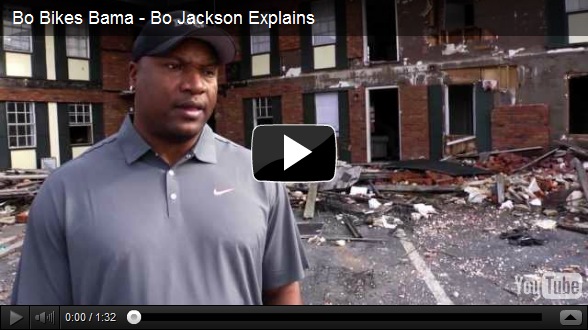
Auburn’s Bo Jackson biking to Bama for tornado relief

By: LivingCrimson

Bo Bikes BamaThis being a Crimson Tide blog, we usually can be found giving Auburn a very hard time. There’s a wee tiny sports feud in Alabama called the Iron Bowl, in case you haven’t heard.

Occasionally, though, along comes a show of character from the opposing camp that everyone can applaud. Enter one of sports all-time greats, Bo Jackson. The Heisman winner and #1 NFL draft pick is putting his considerable muscle behind a relief effort to benefit those in need after the April 2011 tornadoes in Alabama.

Beginning April 24th, 2012, Jackson will be cycling across the State of Alabama through towns and cities ravaged by the tornadoes, ending in Tuscaloosa on April 28th. He hopes to raise $1 million for the Governor's Emergency Relief Fund, which was established to help Alabamians with unmet recovery needs. A staggering $1.2 billion is still needed for the long-term recovery effort.

Sponsored by Nike, Trek and other industry leaders, Jackson also wants to refocus the nation’s spotlight on the continuing rebuilding efforts in the State. The federal government declared Alabama a Category 1 natural disaster ─ the same ranking given to the damage caused by Hurricane Katrina and the terrorism on 9/11 ─ but the vast scope of the tornado devastation is hard to understand without a visual impact. Jackson will video and photograph each area he travels through to remind us all that much work remains to be done.

Kudos to Bo Jackson for giving back to his home state.


Donations to Jackson’s relief effort are handled through the United Way of Alabama here.

Bo Bikes for Bama is also accepting donations of $200 per each leg of the journey to ride along with Bo Jackson. Register and donate online here.

For Tuscaloosa relief efforts, donations to Tuscaloosa Habitat for Humanity can be made here.

Donations to the Nick and Terry Saban Foundation ─ Nick’s Kids 14 for 14 ─ can be made here.


I would love to hear about your thoughts on this article. Post comments to LivingCrimson on Twitter or Facebook.

Thursday, January 20, 2011

The Obligatory Robert Bentley Religion Gaffe Post

image On Monday, as I was busily lining up appointments for a business trip to the Houston Metro Area, newly elected Alabama Governor Robert Bentley was being sworn in as the state’s 53rd chief executive. It was a day of pomp and circumstance that I fully and legitimately expected to pass with little else than blah blah coverage in the media. Inauguration activities are not supposed to be controversial.

But I should have known better because, well…  This is Alabama.

As you’re probably already aware, just after taking the oath of office, Dr. Bentley made the pedestrian trek to the Dexter Avenue King Memorial Baptist Church, famed for being the site of so many stirring sermons by Martin Luther King, Jr. where he delivered a short speech about how he saw his role as Governor of Alabama. But in a moment that surely must have horrified his communications director Rebekah Mason and Bentley supporters across the state, he added this little grenade blast:


''Now I will have to say that, if we don't have the same daddy, we're not brothers and sisters. So anybody here today who has not accepted Jesus Christ as their savior, I'm telling you, you're not my brother and you're not my sister, and I want to be your brother."


Oh my. A statement that took all of ten seconds to utter has now been responsible for the little old country doctor to become famous in all the wrong places. The story was picked up by the national news media; the Twittersphere and Blogosphere went ballistic and the talking heads had talking point fodder for morning shows.

Ben Flanagan of al.com stole a page from my playbook yesterday, and sampled some of the comments from around the web.  As you would expect, these don’t exactly paint a charming picture of the genteel retired physician.


Here's what different news organizations and blogs throughout Alabama and the country are saying about Bentley's comments.

  • The Daily Targum in New Jersey wrote that "Elected officials should not be perpetuating prejudices," as they claim Bentley does with his comments.
  • AOL offers Robert Bentley: 5 Facts About the Ultra-Christian Alabama Governor


Some of the hard left bloggers took even bigger chunks of flesh from the man who hadn’t even been governor for an afternoon before sticking his foot in his mouth.

Here’s my take on the matter, in the form of a question:

Dr. Bentley, did you learn nothing from the saga of former Chief Justice Roy Moore?

I have no problem with a man of faith expressing that faith. Even those  holding public office. I do have a problem with fundamentalists holding office and expressing those views in a way that sounds like you’re prejudiced, even if you’re not. Furthermore, we are locked in a war against a group of religious fundamentalists whose prejudices are so great, they blow themselves up to kill the infidels. The comparisons between Christian fundamentalists and those of the Islamic flavor are inevitable, even if  they’re completely bogus.

Bentley later apologized for his remarks, but you can’t unring the bell. The damage is done.

Rebekah Mason has a huge job ahead of  her.


Click Here for The Wall Street Journal Bloomberg Businessweek

Wednesday, November 3, 2010

A Crimson Red Tide sweeps Alabama

image For the first time since Reconstruction, the Alabama Legislature will be controlled by the GOP. Combine that with a win by Republican Robert Bentley in the Gubernatorial race, a win by Republican Kay Ivey in the Lieutenant Governor’s race, Republican Luther Strange’s win in the Attorney General’s race, complete control of the Alabama Supreme Court and there is no other conclusion: Alabama is now a Crimson Red state.

Via the Mobile Press-Register:


An apparently energized electorate painted Alabama a deeper red Tuesday as Republicans hammered Democrats, winning the governor's office easily and a majority of seats in the Legislature for the first time since Reconstruction.

Dr. Robert Julian Bentley, who until June was a little-known Republican legislator and retired Tuscaloosa dermatologist, was elected Alabama's 53rd governor.

Republican Kay Ivey rode the anti-incumbent tide to upset Jim Folsom Jr., who was seeking a third term as lieutenant governor.

With 95 percent of the vote counted, Ivey, who is completing a second term as state treasurer, had 740,522, votes or 51.3 percent to Folsom's 702,239, votes or 48.7 percent.

Republican Luther Strange defeated Democrat James Anderson in the race for Alabama attorney general tonight.

"I'm honored, I'm happy with the results and I'm ready to go to work for the people of Alabama," Strange said from his campaign celebration in Homewood.

Strange, 57, of Birmingham, campaigned on a pledge to fight public corruption and restore integrity to an office held since 2004 by Republican Troy King.


Alabama Republican Senator Richard Shelby also cruised to reelection, as did AL-01 Representative Jo Bonner.  But in yet another example of the wave that swept the state last night, Montgomery’s Martha Roby swept political rival Bobby Bright out of the AL-02 race, leaving Alabama with one gerrymandered blue District, the AL-07. But with GOP control of the House, the Senate, the Governor’s Mansion, the AG’s office and the whole state Supreme Court, you can expect that District to get retooled in years to come.

Late last month, I implored you to vote a straight ticket.  It looks like many of you heeded that call and I’d love to take credit for starting the ripple that became the wave.  But I can’t pat myself on the back. In truth, the credit goes to the candidates and the Alabama Republican Party, all of whom worked tirelessly to make last night such a historic event. But I don’t doubt that the bloggers, facebookers and twitterers in this state had an impact.  You made history last night.

From the Shoals to the Wiregrass.  From Little River Canyon to the Fish River Bridge, Alabama is now painted in a cheery new shade of Crimson Red.

Tuesday, October 19, 2010

Bentley: "I have not made a single negative ad or recorded a negative message to the voters"

Dr. Robert Bentley is out today with a statement posted on the campaign’s website, regarding the Mobile Press Register story that ran in the Sunday edition.  Allegations in the story were that the Bentley campaign secretly conspired with the Alabama Education Association to pummel his runoff opponent Bradley Byrne with a “barrage of attack ads and automated phone calls.”


FOR IMMEDIATE RELEASE

Contact: Rebekah Caldwell Mason 334-782-4661

NEGATIVE CAMPAIGNING

"I pledged not to run a negative campaign and I have not. I have not made a single negative ad or recorded a negative message to the voters. No member of my staff or any of our hired consultants have ever been authorized by me to make a negative ad. No member of my staff or any of my paid consultants were authorized or directed by me to participate in any third party, independent negative political campaign. I pledged to run a positive campaign and I have done just that. There is no connection between our positive robo-calls and negative attacks ads."

AEA CONTRIBUTIONS

"Unfortunately running a statewide campaign is expensive. I was outspent almost 4 to 1 in the primary. I mortgaged my house, and borrowed from my retirement fund and my life insurance policy just to have the money we needed to stay in the race. I have called on hundreds of people asking for their financial support of my campaign, including AEA. I have acknowledged that contribution and we have reported it on our financial statement with the secretary of state's office. AEA pledged additional support if needed, but we made a decision not to accept further help now or after the election. We are not taking any money directly or indirectly from the AEA now or after the campaign."

ROBOCALLS

"During the final days of the runoff campaign I was contacted by our campaign staff and asked to record positive "robo calls." Which I did. We were billed for calls made during the runoff by Dresner Wickers and Associates and reported those expenditures. We were notified on October 11 of the amount of additional In-Kind expenditures related to robo calls and we immediately reported those in an amended Financial Disclosure Report to the Secretary of State's office. That amendment was filed on October 13. We have made every effort to contact donors, volunteers, and staff to ensure that all in-kind contributions are reported accurately."


The short analysis of this “October Surprise” is that the ordinarily sharp George Talbot flubbed the story in Sunday’s Press-Register.  This statement in the story is the key: “Working through back channels with Bentley’s campaign, the AEA pummeled Byrne with a barrage of attack ads and automated phone calls, according to e-mails and telephone records obtained by the Press-Register.

The problem is, the emails “obtained” by the Press-Register don’t show Bentley’s involvement in attack ads at all.  They do, however, show that operatives on Bentley’s campaign staff worked the backchannels to get AEA’s robocalling system to blast out a series of phone calls in the days just before the runoff election.  Talbot’s unfortunate wordsmithing conflates AEA’s cooperation with the Bentley campaign on the robocalls with AEA’s separate and completely uncoordinated media assault on Bradley Byrne.

This gives the Bentley Campaign an easy out—simply admit to accepting support from AEA but deny—truthfully—that there was any involvement in the attack ads. Then play the underfinanced underdog role while defending the “omission” in campaign finance documents as a miscommunication. Bentley wiggles out of the jam because Talbot’s story accused his campaign of engaging in an activity that the documentation doesn’t demonstrate, and the worst of the two activities alleged is the one with the least amount of evidence behind it.  Follow me, here:

  • Accepting AEA campaign contributions: Bad.
  • Accepting in-kind services from AEA: Bad.
  • Working with the AEA to run negative ads while denying involvement in any negative campaigning: FATAL.

Oh and, by the way.  Pretty much anyone covering or closely following politics in Alabama has seen and read the emails Talbot used in the story.  They’ve been floating around for weeks.  Like I wrote yesterday, there’s no smoking gun there that directly ties Bentley to the negative campaign ads that buried Bradley Byrne.

Ed. Note: The Mobile Press-Register endorsed Bradley Byrne in both the primary election and the runoff.

Monday, October 18, 2010

Paper accuses Robert Bentley of collusion with AEA. But where's the smoking gun?

[NOTE: In the spirit of full disclosure, I first supported Tim James in the GOP primary.  I then voted for Bradley Byrne in the runoff (yes, I picked the loser twice in one primary election).]

image In a story that ran in Sunday’s Mobile Press-Register, Political Editor George Talbot tries to lay out a plot between Republican gubernatorial Robert Bentley and the Alabama Education Association during a tense run-off for the GOP nomination.  Talbot suggests that the evidence contradicts Bentley’s claims of  “innocent bystander” status in an ongoing row between Byrne and AEA.

Talbot says Bentley may also be in violation of the Alabama election law requirement that candidates disclose in-kind contributions in addition to direct cash.

AEA is one of the most powerful political organizations in the state, with a massive get-out-the-vote machine and very deep pockets. Bradley Byrne, who finished first in the primary but was forced into a runoff with Bentley, has been a staunch political enemy of the AEA and its retiring Executive Director, Paul Hubbert.  As the Chancellor of Alabama’s Community College System from 2007 through his 2009 gubernatorial campaign announcement, Byrne was instrumental in Republican attempts to rid the public education system of “double-dippers” and corruption in state Government.  “Double dipping” is the practice of serving in the Alabama state legislature while also holding a teaching or administrative position in state government (i.e., community colleges).

Excerpts from the story (emphasis added):


Bentley, throughout the runoff battle, stayed true to his public pledge not to run negative ads. But privately, a daring strategy was taking shape, according to internal e-mails and interviews with campaign officials.

As election day neared and Byrne’s momentum increased, documents show that the Bentley campaign took a calculated risk — reaching out to Byrne’s archenemy, the Alabama Education Association.

To be effective in a GOP runoff, the collaboration between Bentley and the AEA would have to be secret.

Working through back channels with Bentley’s campaign, the AEA pummeled Byrne with a barrage of attack ads and automated phone calls, according to e-mails and telephone records obtained by the Press-Register.

On the morning of Thursday, July 8, the Bentley campaign was in overdrive.

At 9:45 a.m., Bentley’s campaign manager, Bob Wickers, flashed an e-mail to Stan Pate, a Tuscaloosa businessman and close adviser to Bentley.

“I need you. Can we speak this morning?” Wickers asked.

Pate, according to e-mail records, served as a middle man between the campaign and AEA, a role he acknowledged in an interview last week. He said that Wickers wanted to nail down arrangements for Bentley to record an automated message — known as a “robocall” — that AEA would distribute to voters via its phone network.

Minutes after receiving Wickers’ e-mail and speaking with him, Pate took a call from David Stout, a public relations manager for AEA, he said in the interview last week.

Stout e-mailed Pate with instructions for setting up an account with AEA’s calling service and attached a proposed script for Bentley to read.

Pate said that he forwarded the e-mail to Wickers and business partner Bryan Sanders, who arranged for Bentley to record the call.

On Friday, July 9, Sanders e-mailed Pate to thank him for his help.

“Doc recorded two automated calls today for our friends to drop to their statewide list,” Sanders wrote.

“He will record a third call within the next 24 hours. The call center guys have been notified and the first call will drop today. The second call will drop Saturday. Mike Huckabee has recorded a call to drop Sunday to a different statewide list through a different call center. And the final call will be recorded within the next 24 hours to drop Monday.”

AEA blasted Bentley’s 30-second messages out to more than 500,000 phone accounts daily over the next three days, according to results provided to the campaign by Stout.


Talbot’s piece attempts to tie Bentley’s campaign to a series of blistering AEA ads targeting Bradley Byrne.  Alabama television and radio markets were inundated with negative ads, attacking Byrne for ties to Bill Clinton (Byrne is a recovering Democrat), British Petroleum (the runoff was during the worst of the oil spill), and lobbyists.  The ads were effective in driving down Byrnes’ public approval and probably led to the large margin of victory for Bentley. Bentley won the nomination convincingly 56-44.

But nothing in Talbot’s story ties Bentley to the ad campaign.  The only evidence Talbot shares in the story are a chain of emails between Bentley’s campaign staff and the operators of the largest robocalling organization in the state.  The result of those emails is apparently a set of three calling operations carried out in the week before the runoff vote. If you’re spending money on GOTV efforts in this state, who do you turn to?

Was it shrewd for Bentley’s campaign to turn to a rival political organization’s apparatus?  Perhaps.  But if the Bentley campaign reimbursed AEA for the robocalling effort, or if Bentley’s campaign records show the in-kind services were reported, then there is no violation of campaign law here. Political shrewdness may gall some voters, and the secrecy of the deals that made the robocalls happen may hurt Bentley’s image of the gentleman grandfather turned political reformer. But there’s no law against shrewdness, and in Alabama politics, backchannel deals are as much a part of the game as Coca Cola and Golden Flake.

It’s also worth noting that the AEA brazenly encouraged registered Democrats to cross over and vote for Bentley.  They wanted no part of Byrne in the Governor’s Mansion, and this was a secret to no one.

Where’s your smoking gun, Mr. Talbot?  Where’s the evidence that Bentley’s campaign colluded with the AEA to coordinate a negative ad campaign against Byrne?  And remember, I’m asking this as a former Byrne supporter.

Late last week, the Democrat candidate for Governor, Ron Sparks, lamely accused Robert Bentley of accepting campaign cash from “gambling interests.” And some time last week, The Mobile Press-Register “obtained” emails exchanged between the AEA—a Democrat-aligned political organization—and Bentley campaign operatives.  I seriously doubt that the Bentley campaign was the source of the leaked emails, don’t you?

To my cynical eye, this has all the makings of a coordinated, last ditch effort to knock Dr. Bentley down a few notches with baseless smears. It should also be a very important lesson for the Bentley campaign—you cannot lie with a pit of vipers and expect to be un-bitten.

If this is the best October Surprise you can deliver Mr. Hubbert, then you’re well past the prime of your game, and retirement is coming none too soon.

Monday, October 4, 2010

Defeated Democrat offers warning to fellow party members

image Let me preface this by saying that Artur Davis is everything Barack Hussein Obama has pretended to be.  Davis was born in Montgomery, Alabama and raised by two women:  His mother and grandmother.  He excelled in school, earned a scholarship at Harvard University and graduated magna cum laude.  He later earned his J.D. at Harvard and returned to Alabama to practice law.

Davis is a black, centrist Democrat with principled, if often flawed views on policy matters. But he voted against Obama’s landmark healthcare reform act and stood by his vote despite withering criticism from within his own party, especially the Congressional Black Caucus.  Davis was the only member of that Caucus to vote against the bill.

Davis was first elected to represent the 7th Congressional District of Alabama in 2002, defeating long-serving Earl Hilliard in a brutally contested primary.  Hilliard’s chief campaign issue:  That Davis wasn’t “black enough” to represent the 7th District (a heavily Democratic, majority black District in central Alabama). Davis and Hilliard were forced into a runoff, which Davis then won going away.

Davis’ defeat of Hilliard, his centrist positions and his votes on Capitol Hill strained relationships with Alabama and national black Democrat leaders. Those tensions boiled to the top of the 2010 Alabama Gubernatorial Democrat Primary.  Davis’ campaign was a two-headed disaster.  Poor leadership, combined with a determined effort among state Democrats to defeat him, transformed him from a 30-point favorite in the primary into a 24-point loser at the polls.

In a story that ran yesterday in the Birmingham News, Davis says he is closing the door on Alabama politics, but he has a parting shot for his former “allies:”


Davis, on what could be his last functional day as a member of Congress, did not give a 90-minute farewell interview, because that would imply he was leaving with the good-natured hope that others would fare well in his absence.

Instead, Davis, who went from national rising star to the losing end of a landslide back home, said hyper-partisanship in Washington and open hostility from fellow Democrats in Alabama have left him aggrieved and politically homeless.

Davis now says he ran into racism in a primary that is dominated by black voters. He said he lost black votes because black political leaders -- who disliked Davis' centrist record and go-it-alone style -- successfully convinced black voters that a black couldn't win, and this black in particular shouldn't win.

"The narrative caught hold in the black community that a guy who is not going to get white support is vainly trying to receive white votes and is overlooking the interests of blacks to get votes he'll never get," Davis said.

The state's black political organizations, which he beat in 2002 to win the congressional seat and has been adversarial with ever since, also out-maneuvered him. They used his vote against Obama's health care reform legislation as an example of how Davis neglected his black constituents.

Davis described the second "untold" story of his loss. After Obama won the White House, those organizations and the Alabama Democratic Party wanted a role in deciding whom to recommend for federal appointments around the state, the classic patronage spoil for the victor. Davis, however, came up with his own selection process, one that was not based inside the party. And then Davis' picks were more often heeded by the White House than the party's.

"For the U.S. attorney position in Montgomery, there were some in the Democratic Party who wanted that to be filled by someone who would lay hands off the Democratic Party," Davis said. "I was agnostic about who filled the positions but I wanted a process in place to produce candidates who were Democrats but who were merit-based, selected based on their legal ability."

Washington was increasingly less friendly for Davis, too. Political polarization around the country has both parties catering to their extremes, and moderates become pariahs, he said.

"The greatest disappointment these last two years has been that a country that was seemingly coming closer together is now further apart," Davis said.


Democrats in Alabama—and nationally—will be quick to cast Davis’ disillusionment as a case of sour grapes from a sore loser. But I think his warnings about the hyper-partisanship on the left side of the spectrum should have been heeded long ago.

Davis said that his vote against Obamacare was cast based on what he thought was best for the country, and that his process for selecting merit-based appointees to federal offices were meant to find the best qualified Democrats rather than the best connected political hacks.

This is a constitutional republic with a center-right electorate.  In order to accomplish Reaganesque ideals of limited government and spending restraint—ideals that are supported by consistent majorities in public opinion surveys—Republicans will have to reach out to Democrats like Davis.  These are matters of principle, and principled men like Davis are becoming increasingly rare.

Furthermore, while Barack Obama has proven to be an empty suit and an empty promise of Democrat moderation and leadership, Artur Davis exemplifies the kind of substance and principle that once got Democrats elected even in conservative-leaning states and Districts.  You may not agree with them all of the time, but you’re confident that votes and positions are taken based on principle rather than partisanship.

For the record, Davis predicts that Ron Sparks—the Democrat nominee for Governor—will lose to Republican Robert Bentley, ensuring a third four-year term of GOP control of the office.

Sunday, August 22, 2010

Robert Bentley quietly putting together a Bama Landslide

image Dr. Robert Bentley, a Tuscaloosa dermatologist and member of the Alabama House of Representatives, appears headed for a rarity in Alabama gubernatorial elections—a landslide.  Historically, Alabama’s gubernatorial races are close, hard-fought affairs. Sitting Governor Bob Riley is term-limited, but his first electoral victory in 2002 came by a margin of only about 3,000 votes.  He won reelection easily in 2006 as a popular incumbent.

Bentley’s support grew as the two top GOP contenders—Bradley Byrne and Tim James—battled it out in a nasty, bruising primary campaign.  Bentley ended up second in the primary vote, and beat party favorite Bradley Byrne in the runoff.  Bentley’s low-key personality and gentlemanly primary campaign lured many GOP voters who were turned off by the mudslinging by Byrne and James.

His opponent, Democrat Ron Sparks, doesn’t seem to inspire a lot of faith.  After claiming in his election filings that he had no personal assets, Sparks then loaned his own campaign $500,000 during the primary.  Sparks easily beat the Democrat party favorite Artur Davis, who despite being as blue as a blue dog Democrat can be, found himself tied to President Barack Obama.

On Friday, Rasmussen Reports released its latest polling results for the race:


Republican Robert Bentley earns his highest level of support yet in the race to be Alabama’s next governor.

A new Rasmussen Reports telephone survey of Likely Voters in the state finds Bentley with 58% support, while his Democratic opponent, Ron Sparks, picks up 34% of the vote.  Three percent (3%) prefer some other candidate, and five percent (5%) are undecided.

In surveys dating back to May, Bentley has led Sparks, with support ranging from 44% to 55%.  Sparks has received anywhere from 31% to 37% of the vote.  Last month, Bentley held a 55% to 35% lead in Rasmussen Reports’ first look at the race following his GOP Primary runoff win. 

Bentley, a Tuscaloosa state representative, is favored by 84% of Republicans, while 78% of Democrats support Sparks, the state’s agricultural commissioner.  Among voters not affiliated with either political party, Bentley leads Sparks by an overwhelming 72% - 16% margin. 


It’s the eye-popping support of political independents—a large segment of this traditionally red state—that has Bentley running so strong.  It’s typically a fickle bunch, but it’s difficult to see Sparks swinging many of those indies into his corner.  This is not a year for Democrats in any part of the country, but in Alabama, it’s about as bad as it can get.  Bentley’s low-key, genteel style, Sparks’s campaign finance questions, and the toxic atmosphere for Democrats suggest that Bentley will pull off a rare landslide.

Tuesday, May 25, 2010

Alabama Politics and Alabama Football!

This is that deliciously rare opportunity I get to write a blog post covering my two favorite subjects--politics and Alabama football.  In his weekly sports column for the Mobile Press-Register, writer and syndicated talk-show host Paul Finebaum explains a firestorm of controversy over alleged comments by Republican gubernatorial hopeful, Tim James:

Last Friday, a rumor started floating around that James had blasted Alabama coach Nick Saban at a campaign stop. There were variations on the rumor, one of which had James using a pejorative in front of Saban's name. The other simply said he would cut Saban's nearly $5 million a year salary. Two people told me they heard the comments but the candidate was clearly joking.

The mere mention of the possibility, whether James was joking or not, had tongues wagging and phones melting down on radio talk shows. But before the conversation ever left the earth's atmosphere, James turned a mild tempest in a teapot into a nuclear war -- at least on the most commonly traveled highways where politics and sports intersect.

Finebaum explains that James, like his father and former Governor, Fob James, both went to and played football for Auburn University, Bama's in-state rival (yes, Auburn is actually inside the state of Alabama).  He also notes that James' chief primary candidate, Bradley Byrne, obtained his Master's Degree from Alabama.

Notwithstanding the fact that James, as Governor, has virtually no power over who state university athletic programs hire as coaches, the fact that James is a self-proclaimed "Auburn man" is reason enough for Alabama fans to view his candidacy with suspicion.  You see, in this state--football is not a sport, it is a religion.  Each fall, the athletic equivalent of jihad is declared between two fanbases and emotions don't settle down until sometime in January.

Finebaum makes note of the fact that James committed two mistakes in handling this:  One, he repeated the rumor on Twitter in the process of denying it, thus giving it legs and a longer life in the news cycle and two, whoever posted the denial tweet blamed it on Byrne, a Bama man.  But what Finebaum didn't point out was the fact that public opinion surveys conducted each fall show that Alabama isn't just a red state, it's a "Crimson Red State."  Polling started in the late 1980's and is usually conducted in the week leading up to the annual showdown called the Iron Bowl.  While the Iron Bowl rivalry is a fairly close one on the field (Bama holds a 40-33-1 edge in the series), the rivalry for public support isn't close at all.  Alabama fans routinely outpoll Auburn fans by large margins, from 37-23 in the late 1980's to a nearly two-to-one edge, 64-33, in the late 2000's.

This means that, not only was James joke and denial an 11th hour mistake, it was a mistake that could cost James in the polls.  The primary field for the Alabama Governor's mansion is crowded and most likely headed for a runoff.  James' internal polling showed him with a slim lead last month and other public polling shows a very tight race.  Byrne, the Bama man, is the establishment choice in the race, while James is the maverick with stronger Tea Party support.

I'm going with James in the primary next Tuesday.  I believe the crack really was a joke and I really don't care if a junior staffer manning the Twitter account doesn't understand the sensitivity of how that thing can play out.  Byrne is a good candidate and should he win the primary, I'll throw my support to him.

But if James wins the primary and goes on to beat likely Democrat candidate Artur Davis, I and many other Bama fans will keep a close eye on that Barner.  

Extra Point: Current Alabama Governor Bob Riley -- Bama grad.