On June 16, 2010, BP PLC and the United States Government announced plans to establish what amounts to a $20 billion slush fund, ostensibly aimed at compensating residents and business interests along the Gulf coast for economic and financial damage caused by the Deepwater Horizon oil spill. The White House also appointed Pay Czar Kenneth Feinberg as the fund's administrator, and he immediately took his dog and pony show on the road.
Almost from the beginning, the government has been either confused or silent on the fund's status. In fact, Feinberg told a CNN interviewer that the fund would cover claims arising from the government's deepwater drilling moratorium, only to reverse himself and change the story the very next day.
On August 9, BP announced that it made an "early" $3 billion "deposit" into the fund to show that it's committed to fulfilling its obligation. Waiting nearly two months for the first installment doesn't seem like either the government or BP understands the definition of the term "early," but let's play along.
The real problem here, gentle readers, is that none of the details of the negotiations between the government and BP have seen the light of day. We have seen no contract. We have seen no memorandum of understanding between the two parties. We have not seen even the first set of criteria for establishing claims legitimacy. All we've had is the Kenneth Feinberg Carnival Road Show, with the charismatic and seemingly trustworthy administrator reassuring residents, businesses and local government leaders that it's all gonna be Ok. At least one state attorney general--Troy King of Alabama--smells a rat.
Since the executive branch has no power to compel a private entity to fork over the bucks to fund the kitty, it stands to reason that BP will have great power in establishing the rules by which claims legitimacy deteminations are made. If this is the case, then BP is likely outmaneuvering the boy-king. They let him fist-bump his buddies over shaking down the company for $20 extra-large, but then they use his constitutional inability to compel payment to restrict the boundaries of claims legitimacy. The $20 billion slush fund just becomes a BP-controlled $20 billion savings account. This idea appeals to me in a way--the government doesn't have a stellar track record in preventing fraud when it comes to claims-paying. The Dept. of Justice is still prosecuting fraud cases from the Katrina relief, five years after the storm. While BP might come across as stingy, they're much less likely to pay frivolous or fraudulent claims because it's like, their money.
But again, we don't know anything, because "the most transparent administration in history" has released absolutely nothing.
I frankly believe BP is playing Obama like a cheap Texas fiddle. Bob Dudley cut his governmental relations teeth by doing business with Vladimir Putin and the Russian Mafia Federation. He beat them so badly that he made the company billions, increased its petroleum reserves and was forced to flee Moscow for his safety once Putin's thugs realized the level to which they'd been played. Outflanking this bunch of amateurs in the White House is child's play.
By the way, look at BP's stock performance since mid-June.
Gimme some feedback in the comments.

Showing posts with label BP. Show all posts
Showing posts with label BP. Show all posts
Wednesday, August 11, 2010


Wednesday, August 4, 2010
BREAKING: BP claims victory; says well is in "static condition." UPDATE: Interview with Allen added. UPDATE II: Cement coming, probably tonight
This is a breaking news item. Updates will be added as more information becomes available.
In an overnight press release, BP claimed success in killing the well by slowly pumping heavy drilling mud through the three-ram containment cap:
Cement injection will create a permanent seal on the well, so while the well is in a static condition, it's not technically dead yet. Expect a decision sometime today on whether the cementing procedure will take place. If it does, expect it to be done quickly.
UPDATE: Here's an interview with Admiral Allen, held this morning on New Orleans WWL-TV:
UPDATE II: BP will start pumping cement into the well, using the same procedure. Told ya this would be decided quickly, and that it would start ASAP after the call was made.
Gimme some feedback in the comments.
In an overnight press release, BP claimed success in killing the well by slowly pumping heavy drilling mud through the three-ram containment cap:
Release date: 04 August 2010
BP announced today that the MC252 well appears to have reached a static condition -- a significant milestone. The well pressure is now being controlled by the hydrostatic pressure of the drilling mud, which is the desired outcome of the static kill procedure carried out yesterday (US Central time).
Pumping of heavy drilling mud into the well from vessels on the surface began at 1500 CDT (2100 BST) on August 3, 2010 and was stopped after about eight hours of pumping. The well is now being monitored, per the agreed procedure, to ensure it remains static. Further pumping of mud may or may not be required depending on results observed during monitoring.
The start of the static kill was based on the results of an injectivity test, which immediately preceded the static kill and lasted about two hours.
BP will continue to work with the National Incident Commander and other government officials to determine the next course of action, which involves assessing whether to inject cement in the well via the same route.

Cement injection will create a permanent seal on the well, so while the well is in a static condition, it's not technically dead yet. Expect a decision sometime today on whether the cementing procedure will take place. If it does, expect it to be done quickly.
UPDATE: Here's an interview with Admiral Allen, held this morning on New Orleans WWL-TV:
UPDATE II: BP will start pumping cement into the well, using the same procedure. Told ya this would be decided quickly, and that it would start ASAP after the call was made.
Gimme some feedback in the comments.
Tuesday, August 3, 2010
Government releases suspect tally of oil in the Gulf
Call this the government's "asking price," if you will. Yesterday, the government's Flow Rate Technical Group (FRTG) released a refined estimate of the ... stuff that flowed from the blown out Macondo well that was drilled by the Deepwater Horizon rig. The story appears in today's online version of The Washington Post.
 First things first--the WaPo story gets a few facts wrong. BP has never publicly or independently estimated a flow rate from the well. The initial numbers came from a US Coast Guard estimate on April 24, and all subsequent estimates of hydrocarbon flow came from either the Coasties, or the government's Flow Rate Technical Group. BP may have agreed to (or at least did not dispute) the government estimates, but all of the flow rate estimates are government numbers. Also, the Ixtoc I blowout spilled between 10,000 and 30,000 barrels of oil a day for ten months. Most estimates of the total amount spilled hover in middle of the range at around 18,000 to 20,000 barrels. That means Ixtoc I spilled between 227 and 252 million gallons. The Macondo spill is the worst in US history, but Ixtoc I remains as the worst spill in Gulf of Mexico history and the worst accidental spill in world history.
But the WaPo story also glosses over the fact that the FRTG's numbers are estimates of "stuff" coming out of the well, only some of which is oil. Other "stuff" coming out of the busted riser included reservoir brine, expanding natural gas, CO2 (released and entrained), inert gases, sand and debris. It's not all oil, and it's not all toxic material for the purposes of determining fines. That said, it's still a lot of stuff.
Last of all, keep in mind that the runaway Ixtoc spill--even at its peak discharge--was spewing "only" about 30,000 barrels a day. Are we to believe that the Macondo well tapped such a large prospect that it was discharging more than twice that amount? I think these numbers are highly suspect, which is why I think the FRTG's estimate is just the government's "asking price" for the looming legal battles. While BP never publicly estimated the flow rate, you can bet your last share of the company's common stock that they have been running numbers too, and their numbers won't even be in the same neighborhood as those we're seeing from the FRTG.
Whatever the final numbers turn out to be, Ed Morrissey at HotAir.com puts it all in perspective:
It's also separate from the $3 to $4 billion BP has already spent on response and recovery operations and separate from the $100 million fund for laid off oil rig workers. Ed's right--BP is going to get a whopper of a bill. And yes, the quality of the information (indeed, the quality and timeliness of the response) from the government in the opening days of the slow-motion disaster is suspect as well.
Gimme some feedback in the comments.
The blown-out well in the Gulf of Mexico gushed 12 times faster than the government and BP estimated in the early weeks of the crisis and has spilled a whopping 4.9 million barrels, or 205.8 million gallons, according to a more detailed analysis announced late Monday.
BP's Macondo well spewed 62,000 barrels of oil a day initially, and as the reservoir gradually depleted itself, the flow eased to 53,000 barrels a day until the well was finally capped and sealed July 15, according to scientists in the Flow Rate Technical Group, supervised by the U.S. Geological Survey and the U.S. Department of Energy.
The new numbers once again have nudged upward the statistical scale of the disaster. If correct -- the government allows for a margin of error of 10 percent -- the flow rate would make this spill significantly larger than the Ixtoc I blowout of 1979, which polluted the southern Gulf of Mexico with 138 million gallons over the course of 10 months. That had been the largest unintentional oil spill in history, surpassed only by the intentional spills in 1991 during the Persian Gulf War.
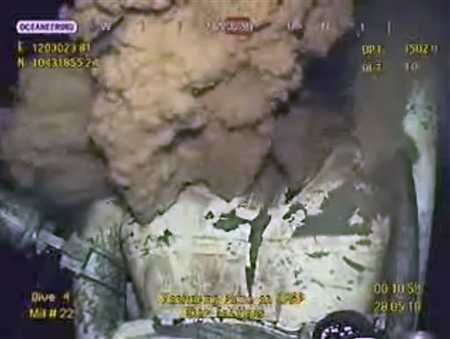
But the WaPo story also glosses over the fact that the FRTG's numbers are estimates of "stuff" coming out of the well, only some of which is oil. Other "stuff" coming out of the busted riser included reservoir brine, expanding natural gas, CO2 (released and entrained), inert gases, sand and debris. It's not all oil, and it's not all toxic material for the purposes of determining fines. That said, it's still a lot of stuff.
Last of all, keep in mind that the runaway Ixtoc spill--even at its peak discharge--was spewing "only" about 30,000 barrels a day. Are we to believe that the Macondo well tapped such a large prospect that it was discharging more than twice that amount? I think these numbers are highly suspect, which is why I think the FRTG's estimate is just the government's "asking price" for the looming legal battles. While BP never publicly estimated the flow rate, you can bet your last share of the company's common stock that they have been running numbers too, and their numbers won't even be in the same neighborhood as those we're seeing from the FRTG.
Whatever the final numbers turn out to be, Ed Morrissey at HotAir.com puts it all in perspective:
To put this in another perspective, the total amount lost in the Gulf represents what the US normally consumes — in six hours. The US consumes just under 20 million barrels of oil a day. That’s less than a couple of years ago, before the economic collapse curtailed energy demand, but still puts us in the number 1 position, almost three times more than China, our closest competitor for the resource (the latter data as of January 2009).
As the Post reports, the calculation of the spill has legal ramifications. At the least, BP will pay $1100 for every barrel spilled, assuming it didn’t act with negligence. If a court finds “gross negligence,” the fine ascends to $4300 per barrel. It’s the difference between $4.5 billion and $17.6 billion, and that is separate from the $20 billion fund to cover damage claims from the spill, which may or may not cover all of the claims.
BP has a big bill coming, and we have a lot of questions to ask about the quality of information coming from the administration’s response team in the first weeks of the disaster.
It's also separate from the $3 to $4 billion BP has already spent on response and recovery operations and separate from the $100 million fund for laid off oil rig workers. Ed's right--BP is going to get a whopper of a bill. And yes, the quality of the information (indeed, the quality and timeliness of the response) from the government in the opening days of the slow-motion disaster is suspect as well.
Gimme some feedback in the comments.
Sunday, August 1, 2010
Markey gets it wrong about the Coasties and Corexit

Markey laments that BP and the Coast Guard's frequent and copious use of the chemical violated an EPA order to BP, which instructed the company to only use Corexit in "rare cases."
The U.S. Coast Guard has routinely approved BP requests to use thousands of gallons of toxic chemical a day to break up oil slicks in the Gulf of Mexico despite a federal directive that the chemicals be used only rarely on surface waters, congressional investigators said Saturday after examining BP and government documents.
The documents show the Coast Guard approved 74 waivers over a 48-day period after the restrictions were imposed, resulting in hundreds of thousands of gallons of the chemicals to be spread on Gulf waters. Only in a small number of cases did the government scale back BP's request.
The extensive use of dispersants to break up oil gushing from BP's Deepwater Horizon raised concerns early on as to what long-term damage the toxic chemicals might be doing to the Gulf's aquatic life. That prompted the Environmental Protection Agency on May 26 to direct BP to stop using the chemicals on the water surface except in "rare cases."
But Rep. Edward Markey, D-Mass., said Saturday that the chemicals continued to be used extensively with Coast Guard approval, often at a rate of 6,000 to 10,000 gallons a day. A request was made and approved on June 13 to spread as much as 36,000 gallons of dispersant, according to data obtained by Markey's Energy and Environment subcommittee.
The EPA directive "has become more of a meaningless paperwork exercise than an attempt ... to eliminate surface application of chemical dispersants," Markey wrote in a letter sent Friday to retired Coast Guard Adm. Thad Allen, the government's point man on the spill.
Markey seems to believe that an EPA order to BP has teeth, but under the Oil Pollution Act of 1990 and the National Contingency Plan developed under that statute stipulate that the Federal On-Scene Coordinator is the federal official whose job it is coordinate and direct the response to the incident. Furthermore, the Joint Incident Command is set up to loosely follow the National Incident Management System, or NIMS. Under NIMS, a single federal official--the Incident Commander--is responsible for directing all activities until the incident is over.
You'll get no argument from me that the federal response was poorly organized and poorly executed. Calling it "organized chaos" would be an insult to chaos organizers everywhere. But as discombobulated as it was, nowhere in the NCP or NIMS is EPA given the power to circumvent or contradict the On Scene Coordinator/Incident Commander/Whatever. EPA, like Fish & Wildlife and other federal agencies may be part of the team, but they take their orders from Allen, not vice versa. Similarly, BP also takes orders from Allen, not EPA.
Markey is just grandstanding during an election year. But you'd think he'd at least read the OPA and the Contingency Plan, right?
Wait... Markey's a liberal Democrat. Never mind...
Gimme some feedback in the comments.
Wednesday, July 21, 2010
Be The One
Be The One.
www.restorethegulf.com
Please note that this is the .com "Restore the Gulf" site, not the .gov propaganda site set up by the regime to cover for its pathetic response and political exploitation of this disaster.
Go visit the site, go sign the petition.
Gimme some feedback in the comments.
Tuesday, July 20, 2010
BP and the government threaten academic independence
The Mobile Press-Register has a thought-provoking editorial in the Tuesday, July 20, 2010 edition, in which it raises the important issue of maintaining academic independence--and by extension, the integrity of science.
Yes, Dr. Bob does deserve credit for turning the oil giant away. But the Press-Register editorial neglects an important point: Bob Shipp chairs the National Marine Fisheries Gulf Management Council. NMFS is a NOAA agency, and hands out millions in grants to researchers each year. The University of South Alabama gets its share of those, as do the other research institutions along the Gulf Coast. For all intents and purposes, he already has a conflict of interest and would likely have been proscribed from working for BP by some arcane, deeply buried language in the grant agreement. He's already heavily involved with federally funded fisheries research, and by all accounts, Dr. Bob is doing stellar work for that group and steadily improving the public's knowledge of the gulf fisheries that support the livelihoods and recreational opportunities of millions of people living on the Gulf Coast. He's a pillar of the Gulf Coast's scientific community and his integrity is beyond reproach.
The Press-Register's editorial comes in the wake of Ben Raines' investigative story that uncovered BP's efforts to corral scientists in advance of the coming legal war. That decades long fight will be between the government and the oil company responsible for the Deepwater Horizon explosion, fire, death of 11 men and the ensuing multi-million barrel spill from the Macondo well the rig was in the process of capping on the night of April 20. It will determine liability and billions of dollars are at stake.
Buried in Raines' story were these interesting paragraphs:
It's pretty clear that the government is playing hardball, too. In fact, it looks like the government is well-practiced in the tactic, forcing scientists to sign non-disclosure agreements that--I'm willing to bet--look an awful lot like the ones BP was asking Gulf scientists to sign last week.
I find it disappointing that the Press-Register's editorial board decided not to address the government's attempts to do virtually the same thing as BP.
BP's attempts to buy and silence scientists should be dragged out into the light of day, where sunshine can properly disinfect the slime and maintain public trust in the scientific analyses, data and conclusions the scientists will ultimately produce in the wake of this disaster. But that coin needs to be flipped, so that the government's own attempts to control the research can be properly scrutinized and disinfected.
If you think the government is going to do any better at ensuring the integrity and trustworthiness of post-Macondo research, look back not only to the NRDA Secrecy disaster of Valdez, but look also at the so-called "ClimateGate Scandal," where at least one prominent climate scientist was all but bribed by the government. Climate scientists who support the government's position on climate change get funded. Climate scientists who question or doubt the government's position seek funding from... other sources.
At risk is the very integrity of science itself. If people are unwilling to trust the research because those paying for it have an agenda, then the honesty of the debate is in question as well as the integrity of the data, the conclusions and the analytical methods. Wrong decisions can get made, with results even more drastic than the problem they're attempting to solve. The dark cloud of "conflict of interest" needs to be removed. Science needs to be funded without respect to agenda, so that the public interest is served, not ideological agendas, policy goals or to wrongfully avoid liability. If government or the private sector wish to fund scientific research, so be it. But remove the non-disclosure agreements and fund the public university research so that the public interest is served.
I should also note that private sector funding of scientific research is not necessarily a bad thing. Without it, we wouldn't have Intel, Apple, AT&T or the myriad of other technology-for-profit marvels.
Gimme some feedback in the comments.
We can't clean the Gulf of Mexico effectively unless we study it. And we can't study it effectively if BP hoards the science.
That's what it appears the company is trying to do by recruiting prominent scientists along the coast, offering them signing bonuses and lucrative pay in return for what amounts to silence on the data they collect.
...
As various scientists are snapped up -- including some already at Southern Miss, Louisiana State University and Texas A&M -- fewer of them will be able to work with federal agencies on anything in their field without a conflict of interest. USA's Bob Shipp deserves credit for rebuffing BP's offer. "There was no way we would agree to any kind of restrictions on the data we collect," he said.
If enough of the region's prominent scientists are muzzled, then so is the science. Now it's up to BP to explain how that's in the best interest of the Gulf of Mexico.
Yes, Dr. Bob does deserve credit for turning the oil giant away. But the Press-Register editorial neglects an important point: Bob Shipp chairs the National Marine Fisheries Gulf Management Council. NMFS is a NOAA agency, and hands out millions in grants to researchers each year. The University of South Alabama gets its share of those, as do the other research institutions along the Gulf Coast. For all intents and purposes, he already has a conflict of interest and would likely have been proscribed from working for BP by some arcane, deeply buried language in the grant agreement. He's already heavily involved with federally funded fisheries research, and by all accounts, Dr. Bob is doing stellar work for that group and steadily improving the public's knowledge of the gulf fisheries that support the livelihoods and recreational opportunities of millions of people living on the Gulf Coast. He's a pillar of the Gulf Coast's scientific community and his integrity is beyond reproach.
The Press-Register's editorial comes in the wake of Ben Raines' investigative story that uncovered BP's efforts to corral scientists in advance of the coming legal war. That decades long fight will be between the government and the oil company responsible for the Deepwater Horizon explosion, fire, death of 11 men and the ensuing multi-million barrel spill from the Macondo well the rig was in the process of capping on the night of April 20. It will determine liability and billions of dollars are at stake.
Buried in Raines' story were these interesting paragraphs:
A scientist who spoke to the Press-Register on condition of anonymity because he feared harming relationships with colleagues and government officials said he rejected a BP contract offer and was subsequently approached by the National Oceanic and Atmospheric Administration with a research grant offer.
He said the first question the federal agency asked was, "'is there a conflict of interest,' meaning, 'are you under contract with BP?'"
Other scientists told the newspaper that colleagues who signed on with BP have since been informed by federal officials that they will lose government funding for ongoing research efforts unrelated to the spill.
NOAA officials did not answer requests for comment. The agency also did not respond to a request for the contracts that it offers scientists receiving federal grants. Several scientists said the NOAA contract was nearly as restrictive as the BP version.
The state of Alaska published a 293-page report on the NRDA process after the Exxon Valdez disaster. A section of the report titled "NRDA Secrecy" discusses anger among scientists who received federal grants over "the non-disclosure form each researcher had signed as a prerequisite to funding."
It's pretty clear that the government is playing hardball, too. In fact, it looks like the government is well-practiced in the tactic, forcing scientists to sign non-disclosure agreements that--I'm willing to bet--look an awful lot like the ones BP was asking Gulf scientists to sign last week.
I find it disappointing that the Press-Register's editorial board decided not to address the government's attempts to do virtually the same thing as BP.
BP's attempts to buy and silence scientists should be dragged out into the light of day, where sunshine can properly disinfect the slime and maintain public trust in the scientific analyses, data and conclusions the scientists will ultimately produce in the wake of this disaster. But that coin needs to be flipped, so that the government's own attempts to control the research can be properly scrutinized and disinfected.
If you think the government is going to do any better at ensuring the integrity and trustworthiness of post-Macondo research, look back not only to the NRDA Secrecy disaster of Valdez, but look also at the so-called "ClimateGate Scandal," where at least one prominent climate scientist was all but bribed by the government. Climate scientists who support the government's position on climate change get funded. Climate scientists who question or doubt the government's position seek funding from... other sources.
At risk is the very integrity of science itself. If people are unwilling to trust the research because those paying for it have an agenda, then the honesty of the debate is in question as well as the integrity of the data, the conclusions and the analytical methods. Wrong decisions can get made, with results even more drastic than the problem they're attempting to solve. The dark cloud of "conflict of interest" needs to be removed. Science needs to be funded without respect to agenda, so that the public interest is served, not ideological agendas, policy goals or to wrongfully avoid liability. If government or the private sector wish to fund scientific research, so be it. But remove the non-disclosure agreements and fund the public university research so that the public interest is served.
I should also note that private sector funding of scientific research is not necessarily a bad thing. Without it, we wouldn't have Intel, Apple, AT&T or the myriad of other technology-for-profit marvels.
Gimme some feedback in the comments.
Friday, July 16, 2010
Day 2, Optimism for the Gulf, dismay for the conspiracy nuts
What a pleasant surprise it was to wake up this morning, grab a cup of coffee, sit down to check the live ROV feeds...
And see that the new cap stack was still holding the Macondo well in check.
It looks like good engineering by real engineers may have finally plugged the damned hole. As both BP and government officials noted, the test is not completed yet, and more than likely, flow will resume from the stack within the next few days. But with the cap's integrity being demonstrated by the minute, the days of uncontrolled flow of crude are done. All but perhaps a tiny trickle will be transported to the surface, processed and transported to refineries in Louisiana and Mississippi. Barring of course, a catastrophic chain of events that conspiracy nuts like Alex Jones and Matt Simmons have been running wild with.
 Unless there's a massive tectonic plate shift causing a cauldron of fire and an Armageddon-ish methane eruption, or something, the end game is near. Maybe now, all those idiotic doom merchants can go find some other New World Order/Bilderberg/Trilateral Commission conspiracy to hawk. I don't care, but please find one that keeps you busy for a while, because I'm tired of the emails. Maybe the disaster nuts who continually claim that BP and the government is lying; that the cap is really just a great big distraction and the Worst is Yet to ComeTM can just drink a big steaming cup of STFU. Just go away. Please don't send me anymore wild-assed YouTube videos or links to kooked out blogs full of black helicopters and stuff.
There's no more to see, here. So please, go away.
At the Mississippi Canyon 252 prospect, aka Macondo, aka aboard the Deepwater Horizon Mobile Operating Drilling Unit, we saw a tragic accident caused by a failure to follow sound engineering and safety procedures. We had the best engineering on the planet, along with the best technology, the best suite of lessons learned, and the best safety protocols in the industry be completely ignored by a company with a history of doing just that. And the government let them do it. But the fact is, it could have happened anywhere, and it's likely to happen again off the shores of South America, Africa or Southeast Asia. And the consequences will be an order of magnitude worse than Macondo. Why? Because banana republics and socialist authoritarian regimes don't have the money, experience or desire to protect life, property or the environment.
This was an accident. It was not an inside job. No, the North Koreans submarines didn't slink out of a Cuban port to torpedo the rig. No, Haliburton did not conspire with BP and Transocean to cripple BP. No, there really isn't a plan to depopulate the Gulf Coast. No, it wasn't a plot by Soros and NALCO to kill the gulf with all that evil, nasty COREXIT. And no, there really isn't a deep sea volcano down there that BP and the government are covering up. Geez Louise, there have been more conspiracy theories cooked up since April 20 than there have been dead pelicans picked up on Grand Isle. If they were half as clever as the nut jobs think they are, they'd have done a much better job of hiding, don't ya think? After all, the lack of evidence is the surest sign that the conspiracy is working.
One more time for the really stubborn hardheads: This was an accident, caused by human stupidity and government incompetence. And, as of at noon CDT today, the catastrophe is still over.

Update: I got so wrapped around my Schadenfreude over the dismayed conspiracists that I forgot to add two important screenshots from testing last night. These are images captured from the BOA Deep C ROV's, which were stationed on the sea floor. The first is from BOA 1, on the bottom near the well. The second is from BOA 2, on the bottom near the well head itself.
 I don't see any methane geysers coming up through fissures in the sea floor, Mr. Simmons. Do you? I don't see any oil blowing out from around the uncased wellhead either, Mr. Simmons. It's probably time to cover your shorts...
Gimme some feedback in the comments.
And see that the new cap stack was still holding the Macondo well in check.
It looks like good engineering by real engineers may have finally plugged the damned hole. As both BP and government officials noted, the test is not completed yet, and more than likely, flow will resume from the stack within the next few days. But with the cap's integrity being demonstrated by the minute, the days of uncontrolled flow of crude are done. All but perhaps a tiny trickle will be transported to the surface, processed and transported to refineries in Louisiana and Mississippi. Barring of course, a catastrophic chain of events that conspiracy nuts like Alex Jones and Matt Simmons have been running wild with.

There's no more to see, here. So please, go away.
At the Mississippi Canyon 252 prospect, aka Macondo, aka aboard the Deepwater Horizon Mobile Operating Drilling Unit, we saw a tragic accident caused by a failure to follow sound engineering and safety procedures. We had the best engineering on the planet, along with the best technology, the best suite of lessons learned, and the best safety protocols in the industry be completely ignored by a company with a history of doing just that. And the government let them do it. But the fact is, it could have happened anywhere, and it's likely to happen again off the shores of South America, Africa or Southeast Asia. And the consequences will be an order of magnitude worse than Macondo. Why? Because banana republics and socialist authoritarian regimes don't have the money, experience or desire to protect life, property or the environment.
This was an accident. It was not an inside job. No, the North Koreans submarines didn't slink out of a Cuban port to torpedo the rig. No, Haliburton did not conspire with BP and Transocean to cripple BP. No, there really isn't a plan to depopulate the Gulf Coast. No, it wasn't a plot by Soros and NALCO to kill the gulf with all that evil, nasty COREXIT. And no, there really isn't a deep sea volcano down there that BP and the government are covering up. Geez Louise, there have been more conspiracy theories cooked up since April 20 than there have been dead pelicans picked up on Grand Isle. If they were half as clever as the nut jobs think they are, they'd have done a much better job of hiding, don't ya think? After all, the lack of evidence is the surest sign that the conspiracy is working.
One more time for the really stubborn hardheads: This was an accident, caused by human stupidity and government incompetence. And, as of at noon CDT today, the catastrophe is still over.

Update: I got so wrapped around my Schadenfreude over the dismayed conspiracists that I forgot to add two important screenshots from testing last night. These are images captured from the BOA Deep C ROV's, which were stationed on the sea floor. The first is from BOA 1, on the bottom near the well. The second is from BOA 2, on the bottom near the well head itself.

Wednesday, July 7, 2010
Feds demand "advance notice" of any BP cash transfers or asset sales
Is there a lawyer in the house? Under what authority can the Obama regime demand advance notice of "any significant cash transfers or asset sales?" Is the United States now a creditor or major shareholder in BP North America?
If BP needs to transfer cash from one of its subsidiaries to another, for whatever reason, it is none of the government's business. If BP decides to sell an asset--such as the rights to drill off the Vietnamese or Venezuelan coasts--then it is free to do so, for whatever reason and that too is none of the government's business.
The BP spokeswoman said that the "demand" was made on June 23, but that as of July 7, it had not responded. If I'm Bob Dudley, I know what my response is, and I wouldn't need two weeks to deliver it:
 SCREW YOU.
Gimme some feedback in the comments.
[BP] confirmed a report in the Financial Times on Wednesday that U.S. assistant attorney general Tony West wrote to the company on June 23. Normally the U.S. Justice Department does not require advance notice of such deals.
BP spokeswoman Sheila Williams said the oil company had not responded to the letter but would do so "in due course." She declined to say whether the Justice Department had set a deadline.
If BP needs to transfer cash from one of its subsidiaries to another, for whatever reason, it is none of the government's business. If BP decides to sell an asset--such as the rights to drill off the Vietnamese or Venezuelan coasts--then it is free to do so, for whatever reason and that too is none of the government's business.
The BP spokeswoman said that the "demand" was made on June 23, but that as of July 7, it had not responded. If I'm Bob Dudley, I know what my response is, and I wouldn't need two weeks to deliver it:

Gimme some feedback in the comments.
Wednesday, June 30, 2010
Chaos and confusion, part deux: the $20 billion slush fund
Just yesterday, we learned about the apparent confusion over who's covered by the $20 billion BP shakedown fund when, during an interview with CNN, the fund administrator told the interviewer that he'd just learned that the moratorium claims would be covered.
But it's a different day today, so it's a different story.
This is not what he said Monday:
There doesn't seem to be any lack of confusion or chaos on the part of the White House or BP, either. In the second story linked above, a White House spokesman said that the $100 million fund would be administered by BP. In the story linked yesterday, Feinberg said he believed he'd be administering the fund. Keep in mind, sports fans, that these two slush funds were established in negotiations between the White House and BP on June 16, two freakin' weeks ago.
So why all the confusion? Maybe it's because there is no document formalizing the agreement. At least, there isn't one that's been made public. As a result, Kenneth Feinberg tells the media one thing on Monday and tells Congress something completely different a few days later.
Who the hell is in charge? $20 billion here. $100 million there. Pretty soon, we're talking about a lot of money, and a tremendous opportunity for waste, fraud and abuse.
Gimme some feedback in the comments.
But it's a different day today, so it's a different story.
Kenneth Feinberg, who is administering the new claims process for victims of the Gulf oil disaster, made crystal clear today that individuals and businesses hurt by the drilling moratorium are not eligible for a piece of the $20 billion escrow fund BP set aside to pay all eligible claims.
"If they send moratorium claims to me what am I supposed to do with them under the $20 billion?" Feinberg said during a break of a hearing of the House Small Business Committee at which he was testifying about his new job. "Those moratorium claims are only going to be paid out of the $100 million."
This is not what he said Monday:
"Yes, I now have discovered -- I didn't realize this until yesterday -- that the moratorium claims will fall under my jurisdiction," Feinberg said in an interview Monday on CNN.
"That's a huge development, and we didn't know that before?" replied the CNN reporter.
"I didn't either," Feinberg said.
There doesn't seem to be any lack of confusion or chaos on the part of the White House or BP, either. In the second story linked above, a White House spokesman said that the $100 million fund would be administered by BP. In the story linked yesterday, Feinberg said he believed he'd be administering the fund. Keep in mind, sports fans, that these two slush funds were established in negotiations between the White House and BP on June 16, two freakin' weeks ago.
So why all the confusion? Maybe it's because there is no document formalizing the agreement. At least, there isn't one that's been made public. As a result, Kenneth Feinberg tells the media one thing on Monday and tells Congress something completely different a few days later.
Who the hell is in charge? $20 billion here. $100 million there. Pretty soon, we're talking about a lot of money, and a tremendous opportunity for waste, fraud and abuse.
Gimme some feedback in the comments.
Relief well ahead of schedule, could kill spill in 14 days?
Finally, some hopeful news on the continuing slow motion disaster in the Gulf of Mexico. The Houston Chronicle reports that independent analysts believe that the drilling of the relief well is sufficiently ahead of schedule that the intercept could be made within 14 days, and the well killed very quickly afterwards:
Before getting too excited over this, it's important to remember that we've been given hopeful news in the past, only to have those hopes dashed by failure or disappointing performance. First, there was the four-story containment dome contraption that failed because of methane hydrates clogging the valves. Then there was the insertion tube strategy, followed by the top kill, kill shot, junk shot and currently, the "lower marine riser package," otherwise known as "top hat." None of these top-down procedures have worked terribly well, but the relief well is a bottom-up approach.
BP is sticking to their August completion date, and performing ranging runs after every few hundred feet slows the drilling process down so engineers can check the aim of the intercept well. They're trying to hit something the diameter of a soccer ball, located more than three miles below the surface, so while plugging the damned hole quickly is good, getting it right is critical.
Gimme some feedback in the comments.
While BP has not adjusted its early August timetable for completing the first of two relief wells boring toward the Macondo more than two miles beneath the Gulf of Mexico seabed, independent drilling engineers and some energy analysts said the company could be in a position to intercept the damaged well and begin the critical kill operation within 14 days.
"Two weeks might be reasonable," said Darryl Bourgoyne, director of the petroleum engineering research and technology transfer laboratory at Louisiana State University, though he added the company still has many steps to complete first.
Before getting too excited over this, it's important to remember that we've been given hopeful news in the past, only to have those hopes dashed by failure or disappointing performance. First, there was the four-story containment dome contraption that failed because of methane hydrates clogging the valves. Then there was the insertion tube strategy, followed by the top kill, kill shot, junk shot and currently, the "lower marine riser package," otherwise known as "top hat." None of these top-down procedures have worked terribly well, but the relief well is a bottom-up approach.
BP is sticking to their August completion date, and performing ranging runs after every few hundred feet slows the drilling process down so engineers can check the aim of the intercept well. They're trying to hit something the diameter of a soccer ball, located more than three miles below the surface, so while plugging the damned hole quickly is good, getting it right is critical.
Gimme some feedback in the comments.
Thursday, June 17, 2010
Joe Barton, the $20 billion shakedown and BP

First of all, Barton is right--this is a shakedown. And not just a garden-variety, DC shakedown. No, this is shakedown of Chicago proportions. Yesterday, BP agreed to place (at least) $20 billion in an escrow account, which is to be managed by a third party, to help compensate those who have lost jobs or livelihoods to the oil spill disaster.
But secondly, I believe it's a perfectly legal shakedown. By all accounts, BP voluntarily agreed to the deal, but you can be certain that Mr. Obama made it clear to company officials that if they didn't do it willingly, it would be done to them. The government can't retroactively force a company to spend money to remediate a disaster for which a law prescribing how remediation is to be paid for already exists. That's what the Oil Pollution Act of 1990 is for, so the administration's threats were a tad on the hollow side. If they'd followed through, then we'd have a whole different discussion about the rule of law.
Thirdly, even though it's a shakedown, and probably just fine under existing law, I believe it's a very bad idea, because it's going to open the door to all sorts of fraud, just like we saw after Katrina and the 9/11 fund. It also does not relieve the company of its obligations under OPA, nor will it provide any immunity from current and sure-to-come future litigation.
Fourth, even though Barton was right, and even though it's a very bad idea, he was still stuck on stupid when he apologized to the CEO of the company who's screwed up safety procedures led to the worst environmental catastrophe in the Gulf since Ixtoc blew out and spilled (by some estimates) 200 million gallons of crude.
BP, the whole United States Congress, the whole executive branch, and every last environmentalist group should look at the American people, and apologize. BP should apologize for screwing up their safety protocols, killing 11 men and spilling crude into the Gulf. The government should apologize for the abysmal failure in oversight manifested in the Minerals Management Service. And all those environmental wacks should apologize for pushing oil and gas exploration far enough off shore that they don't have to look at the rigs. Absolutely none of the above have served the interests of this country, and they should all be shaken down.
Gimme some feedback in the comments.
Tuesday, June 15, 2010
Efficient, well-run government needs to take over BP claims process
If you have been financially harmed by the Deepwater Horizon oil spill, you'd better get your claim into BP. Like, yesterday. Our remarkably well-functioning, hyper-efficient and totally responsive federal government is set to take over the claims process from BP, which the government says is going too slowly:
Obama administration may seize Gulf oil spill claims processing | al.com
When residents of the Gulf Coast ask the government to "do more" in response to the spill, we don't mean yet another power grab. We mean we want you to send more skimming equipment, more motorized beach cleaners and large vacuum tankers to clean up the Gulf.
The last mega disaster to strike this area--Hurricane Katrina--also resulted in the US government handling the claims of hundreds of thousands of Gulf Coast residents who were affected by the storm. How'd that turn out?
Well, hundreds of thousands of legitimate claims were paid, but FEMA wasn't exactly speedy with the processing and if anyone thinks the federal government has gotten better at it isn't cooking a full pot of Gumbo. And, the Department of Justice is still indicting, prosecuting and convicting people for filing fraudulent claims. In three years, more than 900 cases were adjudicated.
Is BP any more effective at rooting out fraudulent claims than the government is? That's impossible to say, but when it's your money being distributed, don't you think you'd try a little harder to separate the victims from the criminals?

Obama administration may seize Gulf oil spill claims processing | al.com
Presidential spokesman Robert Gibbs says the administration is ready to take over the handling of oil spill damage claims from BP if the British company doesn't set up an "independent entity" to do it.
Speaking from Washington, Gibbs said the oil giant's claims processing work has been unsatisfactory. He noted that Obama "has the legal authority" to make the claims process independent. And Gibbs also said "the best way to prevail upon BP is to take the claims process away from BP."
When residents of the Gulf Coast ask the government to "do more" in response to the spill, we don't mean yet another power grab. We mean we want you to send more skimming equipment, more motorized beach cleaners and large vacuum tankers to clean up the Gulf.
The last mega disaster to strike this area--Hurricane Katrina--also resulted in the US government handling the claims of hundreds of thousands of Gulf Coast residents who were affected by the storm. How'd that turn out?
Well, hundreds of thousands of legitimate claims were paid, but FEMA wasn't exactly speedy with the processing and if anyone thinks the federal government has gotten better at it isn't cooking a full pot of Gumbo. And, the Department of Justice is still indicting, prosecuting and convicting people for filing fraudulent claims. In three years, more than 900 cases were adjudicated.
Is BP any more effective at rooting out fraudulent claims than the government is? That's impossible to say, but when it's your money being distributed, don't you think you'd try a little harder to separate the victims from the criminals?

Gimme some feedback in the comments.
Subscribe to:
Posts
(
Atom
)
