This is a long post. If you’re not ready to spend about 20-40 minutes reading it, here’s the tl;dnr version for Facebookers and Twitterers: What’s happening in today’s universities is dangerous, it has happened before, and the Republicans are not the fascists you are looking for.
Get a cup of coffee, turn off the music.
Ready?
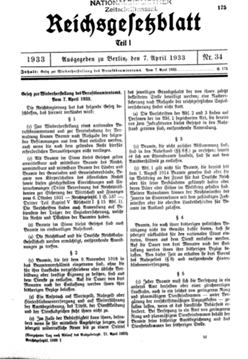
When the National Socialist German Workers' Party came to power in the 1932 elections, one of their first orders of business was the passage of the Law for the Restoration of the Professional Civil Service, which made sweeping changes to civilian public service for everything from federal bureaucrats in Berlin to town dog catcher in Vilseck. Everyone had to become a Nazi if they ever hoped to have a job in the new Reich, and they had to either toe the party line, or…
The entire educational system in the country was caught in that net, including some of the oldest and most classically liberal universities in the world. From these universities flowed influential literature, philosophy, theology and science that had shaped western civilization for centuries. The change was a monumental paradigm shift that contributed in part to the largest conflagration in history.
Peter F. Drucker was an influential Austrian economist and business management pioneer who developed many of the business management concepts that are—for now—still being taught in major western universities. He fled the Nazi regime in 1933 and became a naturalized US citizen in 1943. From 1931 through 1933, he was an economics lecturer at his alma mater, the University of Frankfurt. Below, he describes the first faculty meeting held at the school after the civil service act went into effect:
Frankfurt was the first university the Nazis tackled, precisely because it was the most self-confidently liberal of major German universities, with a faculty that prided itself on its allegiance to scholarship, freedom of conscience, and democracy. The Nazis knew that control of Frankfurt University would mean control of German academia. And so did everyone at the university.
Above all, Frankfurt had a science faculty distinguished both by its scholarship and by its liberal convictions; and outstanding among the Frankfurt scientists was a biochemist-physiologist of Nobel-Prize caliber and impeccable liberal credentials. When the appointment of a Nazi commissar was announced . . . every teacher and graduate assistant at the university was summoned to a faculty meeting to hear this new master, everybody knew that a trial of strength was at hand. I had never before attended a faculty meeting, but I did attend this one.
The new Nazi commissar wasted no time on the amenities. He immediately announced that Jews would be forbidden to enter university premises and would be dismissed without salary on March 15; this was something that no one had thought possible despite the Nazis’ loud antisemitism. Then he launched into a tirade of abuse, filth, and four-letter words such as had been heard rarely even in the barracks and never before in academia. . . . [He] pointed his finger at one department chairman after another and said, “You either do what I tell you or we’ll put you into a concentration camp.” There was silence when he finished; everybody waited for the distinguished biochemist-physiologist. The great liberal got up, cleared his throat, and said, “Very interesting, Mr. Commissar, and in some respects very illuminating: but one point I didn’t get too clearly. Will there be more money for research in physiology?"
The meeting broke up shortly thereafter with the commissar assuring the scholars that indeed there would be plenty of money for “racially pure science.” A few of the professors had the courage to walk out with their Jewish colleagues, but most kept a safe distance from these who only a few hours earlier had been their close friends. I went out sick unto death—and I knew that I was going to leave Germany within forty-eight hours.
What followed was a systematic purging of any notion of the free exchange of ideas. Matters once discussed in open, free debate were at once settled. There would be no rebuttal to Nazi ideology on any subject. A famously open university renowned for its cultural influence became a powerful part of the Nazi propaganda machine. “The science was settled.”
In his book, The Closing of the American Mind, University of Chicago professor Allan Bloom describes a process in the American university that began in the late 1950’s and accelerated through the 1960’s. Bloom argues that the changes in the American university have led to a snuffing of debate and critical thinking. Ideas that one may rightly or wrongly judge as abhorrent are no longer defeated by superior science or logic, but by force.
Today, no conservative speaker, lecturer or professor is allowed to step foot on a major university campus without facing angry and often violent protest. Student associations, led and egged on by leftist faculty, will go to almost any means necessary to prevent the sharing of ideas that do not comport to their ideology.
Bloom also draws compelling parallels between what occurred in 1930’s Nazi Germany to what’s occurring today. What may surprise many readers is that Bloom’s book was first published in 1987. What should not surprise anyone is that far left critics reacted to the book as a demon would react to holy water and a cross.
In 1930’s Germany, books by Jewish authors or books with classically liberal ideas were systematically burned by the Deutsche Studentenschaft (German Students' Association) in large ceremonies held in town squares. Today, exactly three copies of Bloom’s book are still available at Harvard University’s Library. Conversely, there are hundreds of copies of Karl Marx’s Das Kapital.
Some people argue that the rise of computer technology, the internet and electronic social media have fundamentally changed modern culture and that any parallel between Nazi Germany’s seizure of university thought and today’s university thought are invalid. This is false.
If anything, technology has only accelerated the propagation of politically correct propaganda. Indoctrination took years before radio and motion pictures. It took months before the advance of the net. It only takes minutes now.
A contemporary of Peter Drucker was Martin Heidegger, who was appointed rector and chancellor of Freiburg University in April 1933. He formally joined the Nazi Party one moth later. Heidegger espoused a policy that held that free expression, dialogue and open debate were selfish, irresponsible and counterproductive. Instead, faculty and students were expected to fulfill their obligation to promote Nazism in both “in both thought and deed.”
The modern university may be better connected than ever before, but the university is still the place where young minds are taught how to think. If you’re going to appropriate and control how society thinks, school is the place you start.


 And… from this