Showing posts with label Conference Realignment. Show all posts

Wednesday, May 23, 2012

TCU’s Del Conte chooses words poorly, hysteria ensues

image The conference realignment feeding frenzy has gotten to the point where someone is gonna get hurt. peaking at an event in Lubbock, TX, TCU Athletic Director Chris Del Conte was heard saying that the Big 12 was so vibrant that it has “schools like Florida State, Clemson and Miami trying to get in." 

There have been rumors for weeks that the new ACC media deal left some of the conference’s premier football members feeling shortchanged enough to start looking elsewhere. That was further fueled by 247Sports’ Florida State crew announcing that FSU and Clemson had informed the ACC that they were exploring options. That story remains unconfirmed. Today’s Morning Six Pack noted a story in which a CBS Sports reporter attempted to conflate a discussion between the Big 12 and Notre Dame on Olympic Sports with a full fledged courting of the storied football power.

People are stretching for stories and sooner or later, the credibility axe is going to fall on an overextended neck. So, when Del Conte issued his [ahem] “confirmation” that three of the biggest football powers in the ACC were scaling the walls of the Big 12, the innerwebs went BOOM.

“Not so fast” says Stefan Stevenson, the TCU beat writer for the Fort Worth Star-Telegram.


image


image


Del Conte says he was referring to how the Big 12 had grown in stature since last year—when the 2011 realignment craze looked like it was about to gut the league—and was using the rumors of interest from ACC schools as an illustration of how things changed.

Whether you believe he’s simply walking back comments that accidentally provided the story-starved media with red meat or you believe he’s clarifying marks that were misunderstood doesn’t matter. What does matter is that in this hyper-reactive environment, doesn’t it make sense to wait until the suits call a presser before you rearrange the pieces on the board?

Follow me on Twitter and Facebook.

Monday, May 7, 2012

Big East Turnover: Do college presidents have too much power?

image Do college presidents have too much power over athletics? That's a question that SI's Stewart Mandel attempts to answer in a column today, posted in reaction to the news that Big East Commissioner John Marinatto abruptly resigned over the weekend.

Reports that surfaced during the day indicated that Marinatto was forced out, and that the decision to make a change had been percolating for weeks.

Mandel notes that the top executives at major schools have taken an about-step over the last several years. No longer are they leaving critical athletics negotiations regarding conference alignments and media rights deals to the athletic directors and their staffs.

Instead, they're much more ahh... what's the word... tactile.


Originally Published on SI.com - NCAA Football | shared via feedly

Kudos to former Big 12 commissioner Kevin Weiberg (who left in 2007) and Big East commissioner Mike Tranghese (2009) for getting out when they did.

Over the past decade, university presidents and chancellors have exercised a more hands-on role in major athletics decisions, and while the intent is noble, it's hard to see how athletics has benefited. Having a bunch of distinguished physics professors and English scholars help negotiate billion-dollar television packages makes about as much sense as having conference commissioners deliver physics and English lectures.

In the ideal working dynamic, the presidents put their trust in the hands of a capable commissioner like Mike Slive or Jim Delany to do the heavy lifting, then come in at the end to give their stamp of approval. Pac-12 presidents took little time before entrusting their 2009 hire Larry Scott, and in turn he's radically reinvented that conference and made the presidents' institutions a whole lot of money.

Contrast that to the Big 12, where Beebe walked into a mess of conflicting egos and political grandstanding that only grew worse when Realignment Mania kicked into high gear two years ago. First Texas and Nebraska butted heads, then Texas A&M and everybody else. When schools started fleeing, the presidents first kicked Beebe to the curb, then, under the direction of interim successor Chuck Neinas, proceeded to adopt nearly all the key recommendations (equal revenue sharing, grants of TV rights) Beebe had been pushing for years.


It's true that presidents are also becoming more attuned to the financial performance of their institutions, and it's also true that during an era of increased state budget pressure, athletics revenues are playing a larger role in that financial performance.

Anyone who doesn’t think college athletics isn’t time business today hasn’t been paying attention.

We haven't conducted any detailed financial studies, but after laughing at and throwing away the farcical financial submittals made to the NCAA by member institutions, we'd lay some strong odds that athletics have become a massively bigger pump on the income side of the balance sheet.

Last year, The Big East conference turned down a $1.9 billion media rights deal with ESPN. Reports at the time indicated that Marinatto's hands were tied by the conference's presidents, who thought they could get a better deal in negotiations with other outlets, including NBC and CBS.

But note well in the story linked above:  At the same time those presidents were instructing Marinatto to say "no thanks" to the World Wide Schemer, at least two of them were in behind-the-scenes discussions with the Atlantic Coast Conference to abandon the Big East and join the ACC.

Note well also that the gist of the story linked above isn't that the presidents were playing hanky panky and hanging Marinatto out to dry. It was that ESPN was allegedly advising the ACC on which schools to rob from the Big East.

Pitt and Syracuse later announced plans to join the ACC.

Look, ESPN is part of the Disney corporation. Disney--and by extension ESPN--has a fiduciary duty to seek business relationships that deliver the greatest value to their shareholders. That is their sole responsibility under their articles of incorporation. If you have shares in a mutual fund, a 401(k) contribution or some other managed retirement account, be thankful for that. They owe nothing to the conferences, their commissioners or the schools they represent.

When that much money is dangled in front of a president facing tightening budgets and increasing pressure from boards of regents and trustees, they might do something that benefits the school at the expense of athletics.

They might also put good men—like Marinatto, Beebe and Weiberg—in impossible situations, then vote to fire them when they don’t deliver a miracle.

Who can you trust, in situations like that?

Follow me on Twitter and Facebook.

Tuesday, March 6, 2012

Might the SEC tweak the division rotation system to maintain permanent rivalries?

image Over at sbnation.com’s TeamSpeedKills, Year2 has an interesting post on how to tweak the rotation of interdivision games in an eight-game schedule. It both maintains the permanent rivalry games between Alabama and Tennessee and Georgia and Auburn and allows for all of the league’s programs to meet at least once over a six to seven year period.

Maintaining the storied rivalries within the league has to be a priority for decision-makers because these are the matchups that form the very fabric of the league’s appeal. They seem to be getting it—both Year2’s post and a report earlier this week noting comments from South Carolina’s Harris Pastides show strong support within the league for keeping these marquee matchups.

There are two ways of doing this: installing a nine-game schedule to accommodate a better rotation between the two divisions—a possibility that people could probably accept as a reasonable tradeoff—or getting creative with the rotation scheme, like Year2 does.

Let’s take a look:


This is something I've thought about before, so here's an example rotation I made a while ago using Alabama. I picked the Crimson Tide because its first alphabetically, and the rotating East teams go through alphabetically as well. For the second half, teams have to get moved around in order to switch the home/road arrangements.

Year 1: Florida, at Tennessee

Year 2: at Georgia, Tennessee

Year 3: Kentucky, at Tennessee

Year 4: at Missouri, Tennessee

Year 5: South Carolina, at Tennessee

Year 6: at Vanderbilt, Tennessee

Year 7: Georgia, at Tennessee

Year 8: at Florida, Tennessee

Year 9: Missouri, at Tennessee

Year 10: at Kentucky, Tennessee

Year 11: Vanderbilt, at Tennessee

Year 12: at South Carolina, Tennessee

With this system, a fifth-year senior would face 12 of a possible 13 SEC schools before his time is up. It would also make sure that every team plays each other conference opponent at least once every six or seven years, which is a lot better than the alternative of needing 12 years to complete an entire rotation.


The nine game schedule has three important benefits for the league. One, it ensures that interdivisional rivalries are kept alive, and it allows Georgia, Florida, Kentucky and South Carolina to keep their non-conference rivalries alive. Two, it doesn’t force programs to choose between the rivalry game and a non-conference patsy game for bowl eligibility purposes. Three, it creates a better conference game inventory and more media revenue for the league. But it reduces opportunities to schedule other big non-conference opponents, like the 2011 LSU vs. Oregon game and 2012 Alabama vs. Michigan matchup. It also creates heartburn by coaches and administrators who worry about adding another conference game, seven more losses league-wide and unbalanced home-away conference schedules.

The eight game schedule alleviates the latter concerns. With a creative rotation scheme like the one above, the permanent rivalries are maintained and there’s still enough room in the non-conference schedule to permit the East’s non-conference rivalries and the big time matchups we’ve had the last several years. It doesn’t create as many conference matchups as the media partners would like, but it does create more than the current 6-1-1 rotation over the 12 year period.

Year2 goes on to confidently predict that the league will ultimately settle on the eight game slate with a rotation similar to what he’s described. The mix hasn’t even started hardening yet, and don’t count out the influence of what the powers-that-be decide to do with the postseason. But I wouldn’t bet against the creative eight game schedule.

Notice also that the scheduling decisions made by other leagues don’t enter into this discussion at all. The fact that other conferences are going to or are considering nine game schedules has zero influence on the SEC’s deliberations. All of the cultural, political, traditional and financial considerations are unique to the SEC. What the other cool kids are doing is totally irrelevant.

Follow me on Twitter and Facebook.

Saturday, March 3, 2012

A nine game schedule may be a necessary tradeoff for the SEC

image When the Southeastern Conference added Missouri and Texas A&M to college football’s premier conference, one of the first issues it had to address was scheduling. In the process of developing the 2012 conference schedule, the problem of maintaining interdivisional and non-conference rivalries in an eight game schedule really came to a head.

The one thing that should never be lost are the traditional rivalries in the league. Alabama vs. Tennessee and Auburn vs. Georgia are two of the premier games of the season. These are cherished rivalry games that put the league’s storied tradition on display every year and no scheduling scheme should ever eliminate them.

In addition, Florida, Georgia, Kentucky and South Carolina have traditional non-conference rivalries with Florida State, Georgia Tech, Louisville and Clemson, and those should also be placed at the top of the list of priorities for scheduling.

Maintaining traditional rivalries while also giving fans and media partners a better inventory of football games can be done, but not with the 6-1-1 format of playing all divisional opponents, one permanent interdivisional rivalry opponent and a rotating interdivisional opponent each year. That format blunts the impact of adding the two new programs.

So the cost of growth should come at the expense of the eight-game schedule. It should not come at the expense of ending storied rivalries.

As many others have pointed out—and as this blog explained last October—the nine game schedule causes a lot of indigestion on the part of administrators and coaches. Adding another SEC game causes heartburn for the coaches, and administrators don’t like the idea of giving up an SEC home game every other year. Both objections are understandable. Coaches get paid to win games and adding a ninth game makes that more challenging. Administrators get paid to deliver revenue and nothing pays the bills like home games.

But maintaining the marquee games in the league is of paramount importance. They are the showcases of the league and continue the cherished traditions that have made the SEC the country’s premier conference. There is absolutely nothing in college football that’s better than the atmosphere leading up to and surrounding these matchups. They are circled on millions of calendars across the south. They are looked forward to with such anticipation that the thought of eliminating them would never even cross the minds of the fans and the players, both current and former.

Ask Barry Krause what the Third Saturday in October means to him. Ask Herschel Walker what the Deep South’s Oldest Rivalry means to him. Ask any Bama or Auburn season ticket holder what he thinks. It’s a no-brainer.

Maintaining that thread to the past is so important, it’s worth the tradeoff of a ninth league game, and it may well be the only way to do so.

Follow me on Twitter and Facebook.

Thursday, February 9, 2012

Conference USA chief begs for mercy

image Interesting blog entry from Brad Wolverton of the Chronicle of Higher Education on the latest temblor in the ever changing tectonic shifts of conference realignment.

Earlier this week, the University of Memphis formally announced that it had accepted the Big East’s invitation to join the league beginning in 2013 for all sports.

Memphis makes the fourth member of the non-automatic qualifying Conference USA to leave for the Big East, joining Houston, Southern Methodist and Central Florida.

Wolverton notes a statement by Britton Banowsky, commissioner of the oft-raided league of mid-majors:


“Based upon my conversations with commissioner Marinatto, the Big East has now completed its future membership plan,” Banowsky said. “If this is true, it is very helpful as we can now move forward with our plans in a more stable national environment. We hope that the other conferences appreciate the value of stability in intercollegiate athletics and higher education.”


Which Wolverton interprets (as I do) to mean: “Would everyone just back the hell off and leave us alone? You’re killing our efforts to assemble and maintain a stable conference over here, y’all! Damn.”

C-USA and the Mountain West—the other league raided during conference realignments—are attempting to merge and create at least a facade of a conference with football success. As it stands now, the merged league will include Southern Miss, East Carolina and Colorado State as the only programs with a football pulse. Southern Miss is the only one of those who were original members of C-USA.

Poor UAB—who left the Sun Belt to join the once-promising new league—is arguably the school most hurt by the dissolution of C-USA. If any of the three listed above get a call from one of the major conferences, the Blazers’ schedule goes south in a hurry and with it, the attendance figures the program desperately needs to convince decision-makers to let it go forward with new stadium plans. At least one writer even thinks they should (but won’t) consider returning to its Sun Belt roots.

For now though, Banowsky and the schools left from the Big East’s recent pillaging are just hoping no one else swoops in and cherry picks the remaining schools with programs not on life support. Begging for mercy sounds like a good idea—it may be the only move left.

Follow me on Twitter and Facebook.

Thursday, January 26, 2012

Big 12’s Chuck Neinas unloads on Big East and Mizzou and gets facts wrong

image Big 12 commissioner Chuck Neinas gave a blistering interview to the Charleston Gazette and in his little fit of rage over uncertainty regarding West Virginia’s ability to get out of the Big East and play football in his league, got his facts screwed up.

Neinas would have you believe that the Big East is acting like spoiled brats in keeping West Virginia in their conference for the 27-month period stipulated by Big East rules. This is false. The litigation between the Big East and the breakaway Mountaineers isn’t about keeping the school in the league at all. It’s about a dispute over how and when the school can leave. The two parties have agreed to enter nonbinding arbitration and there are legitimate hopes that a settlement can be reached.

Neinas would also have you believe that the SEC “poached” his conference by inviting Missouri to join Texas A&M, a school that had already made the move and laid the legal groundwork for Mizzou to follow. But published documents show that it was Texas A&M and Mizzou that approached Mike Slive, not the other way around. The SEC didn’t have to expand. It was just fine at 12 members until Texas A&M quietly began exploring realignment. The SEC was just fine at 13 members too, until Mizzou quietly began exploring the possibility of following the Aggies. Slive wasn’t hunting on posted ground, as Neinas’ comments suggest.

Finally, Neinas would have you believe that the Big 12 is in the situation that it finds itself in because Missouri was “selfish.” That’s the biggest laugher of Neinas’ comments. The Big 12 is where it is today because the University of Texas made a business decision that suits the Longhorn program’s business interests and stuck to their guns when the other schools in the conference realized that what was good for Texas wasn’t necessarily good for the Big 12 as a whole. In other words, as my friend BanditRef puts it on Twitter, “Texas made it clear it was a business, Mizzou made a business decision.” 

We understand that the Big 12 is nervous. They are contractually obligated to release the 2012 schedule on February 1, and they plan to include West Virginia in the rotation. There is legitimate concern over the uncertainty surrounding the Mountaineers ability to compete in the league next year. Millions of dollars are at stake, as are the schedules of the other teams in the league.

But the Big 12’s problems are problems of their own making.

Follow me on Twitter and Facebook.

Wednesday, January 25, 2012

The 2012 Conference Realignment Season in full swing!

image Remember how much fun the 2011 Conference Realignment Season was?

The Big 12, the SEC, the Big East, even Conference Jambalaya were reshuffled to one extent or another during a months-long ride on a dizzying carousel. It broke longstanding regional bonds, ended traditional rivalries and tested the trust of conference commissioners, university presidents and fans.

The 2012 season is just beginning.

Yesterday, Navy and the Big East announced that the service academy would end its status as an independent and join the conference beginning in 2015 for football only.

And in another development, the Chronicle of Higher Education’s Brad Wolverton reports that sources say that the Big 12 will also reopen conference expansion talks, with the possibility of expanding back to 12 members on the table.

Wolverton was told that possible candidates for admission are Louisville, a Big 12 candidate last year, and current independent Brigham Young.


Further Big 12 expansion is “very possible,” two high-ranking sources told The Chronicle. An expansion committee, dormant for months after the conference accepted West Virginia and TCU into league play, will meet today to discuss its options.

While conference officials stressed that no decision is imminent–and there is some opposition to moving beyond the current 10 member institutions–two schools are at the top of the list, should the league make a move.

Louisville, which the Big 12 considered adding last year, is the likeliest choice, according to people with knowledge of the talks. And Brigham Young, another university the conference has considered, continues to be a possible target. One official said the league was open to adding just one institution. “The Big Ten made 11 work for a number of years,” the source told The Chronicle.


Geography played only a backup role in the 2011 round of reshuffling. It’s a coin flip as to whether commissioners and university officials incorporate that novel concept in 2012.

It’s also worth noting that the conference commissioners have already met once to discuss the future of the BCS, with more meetings to be held in the months ahead. Ironically, the BCS’ system of automatic qualification for the five major conferences is on the table at the same time that AQ status is driving conference realignment.

The period between spring drills and fall camp is normally a very quiet time for college football enthusiasts. That all changed with the 2011 season and it looks like the 2012 season will be just as interesting and just as unpredictable.

Follow me on Twitter and Facebook.

Monday, November 7, 2011

SEC to move to a nine game schedule?

image South Carolina President Harris Pastides said Sunday that the Southeastern Conference will play a nine-game conference schedule beginning in 2012, according to The Daily Gamecock. This means that all SEC schools would play three non-conference opponents rather than four.

For South Carolina, one of those would be Clemson. For Georgia, there's Georgia Tech and Florida would retain Florida State. No word yet on whether Kentucky would maintain its rivalry with Louisville, but some have expressed the opinion that under a nine-game format, the ‘Cats would drop it.

The nine-game schedule also necessitates half of the conference playing five away games and four home games each year, while the other half plays four away and five at home. This means that at best, half of the conference will get seven home games unless they have scheduled a neutral site game against a non-conference opponent, in which case they will have six at home (six home, five away, one neutral). The other half of the conference will have eight home games, or seven if they have a non-conference opponent at a neutral site.

Alabama is scheduled to play Michigan in Cowboys Stadium to open the 2012 season. Auburn is scheduled to open against Clemson in the Georgia Dome, and Tennessee will meet North Carolina State in the Georgia Dome as well. 

We’ll know more once the new conference schedule is announced, but moving to a nine game schedule would twist many ways. For one thing, it could be the end of the non-conference, neutral site matchups. It may also mean the end of the home-home agreements such as the Alabama vs. Penn State series.

The SEC schedule with 12 teams is a tough enough slate. Add one more conference game and the pressure mounts to keep non-conference cupcakes on the schedule while jettisoning the tougher matchups. The schools with non-conference traditional rivals—Kentucky, Georgia, Florida and South Carolina—will be under even more pressure to do so.

It’s hard to see even a majority of the SEC AD’s and coaches in support of a nine-game conference schedule, and in his interview with Mizzou’s official athletics department media, SEC Commissioner Mike Slive said the league would keep its eight-game format.

UPDATE: SEC Spokesman Charles Bloom says there have been no discussions regarding a nine game schedule. Somebody should alert Dr. Pastides.

Follow me on Twitter and Facebook.

Sunday, November 6, 2011

SEC East welcomes Missouri

image Early Sunday morning, the Southeastern Conference made it official (no, for real this time). The University of Missouri will join the SEC and compete in all sports for the 2012-13 academic year.

ESPN’s Andy Katz reports that the Tigers will join the SEC East. GatorSports.com’s Pat Dooley reports the same. UPDATE: Dooley’s story is up now. These are credible enough sources to say with some safety that the league chose the least disruptive option in determining conference alignments for the two new members of the country’s premier college conference.

These reports also validate the news from late last month, when it was learned that Missouri had the necessary votes to enter the league barring any legal obstacles and pursuant to the divisional alignment that puts Texas A&M in the SEC West and Missouri in the SEC East.

There were a solid bloc of “NO” votes in the conference if Missouri and Texas A&M both entered the SEC West and it appears that the sanity that bloc insisted on has prevailed.

Eventually, the league may want to consider a nine-game conference schedule, without which teams in the conference might not see members of the other division on their schedule but once ever 426 years, or something. At least for the 2012 football season, it appears an eight-game conference schedule will be in place, with permanent cross-divisional rivalries such as Alabama – Tennessee and LSU – Florida preserved for well into the future.

Follow me on Twitter and Facebook.

Friday, October 28, 2011

CBS’ Tony Barnhart gets future SEC divisional alignment right

image Tony Barnhart is one of college football’s most respected writers. Known as “Mr. College Football,” the former Atlanta Journal-Constitution columnist now writes for CBS Sports.

So, when the Southeastern Conference wanted to get media perspective on the Missouri to SEC story, who else would they want a sit-down with?

When the SEC website goofed last night and posted several pages of content announcing a move that hadn’t happened yet, it included a Q&A with Barnhart on what impacts the new members would have on the conference.

The interview that didn’t happen included this exchange:


SEC Digital Network: How much sense does it make to now have 14 teams in the SEC and how does that help the issues that you may see with 13 teams, such as scheduling?

Tony Barnhart: “Could the conference make it as 13 schools for one year? Sure; the scheduling models are done. The Mid-American Conference has done it, so there are ways for it to be done. But it’s not  easy; this simplifies it. I don’t know what the conference will decide to do. To me, the logical thing would be to take Missouri and put them in the east. It’s not that far from Lexington, Ky. If you put them in the East, have Texas A&M stay in the west, then you play the other six teams in your division and have one permanent crossover on the other side. You would make Missouri and Texas A&M the permanent crossover. To me, that is the least disruptive thing to do. No matter what, you want to maintain some of the better crossover games in the divisions.”


Well, now. Where have we heard that before?

Barnhart is absolutely right, of course. Splitting the new conference members between the two SEC divisions makes the most sense because it is the least disruptive thing to do. It preserves the balance of power between the two divisions. It maintains existing inter-divisional rivalries. It eliminates the need for drastic reorganization of conference schedules and it also eliminates the possibility of a nine-game conference schedule.

In fact, there’s pretty solid information that this is exactly what the SEC plans to do when it formally accepts Missouri. It doesn’t look like anyone in the current SEC West division will be escaping to the SEC East to “accommodate” the addition of Missouri. Gone also are the nutty ideas of SEC schools giving up a home game every other year to “accommodate” a nine-game schedule.

Those ideas would have worked to the benefit of one SEC school—Auburn—and to the detriment of virtually every other. Those who would have been hurt the most—Alabama, Tennessee, Georgia and Florida—would have seen cherished rivalries either eliminated or greatly diminished in impact and value.

I hope that Mr. Barnhart uses his considerable gravitas to champion the idea of placing Missouri in the East and Texas A&M in the West (or vice versa). These are fluid, unpredictable times and it’s inevitable that change will occur in places we’d have liked to keep the same. But when the opportunity arises to protect storied traditions and minimize disruption, it should be taken.

Follow me on Twitter and Facebook.
SEC website hiccups, Twitter goes BOOM

image A head will likely roll down the steps at XOS Digital today.  XOS is the Southeastern Conference digital content developer and operates the league’s website. Last night, somebody at XOS mashed the wrong button and accidentally published drafts of web content announcing that the University of Missouri had officially joined the SEC last weekend.

The content was quickly discovered and posted on message boards, then found it’s way to Twitter where it promptly went viral. Within an hour of being discovered, the Missouri-to-SEC gaffe was in a serious trending competition with reaction to the St. Louis Cardinals’ remarkable comeback in Game 6 of the MLB World Series. Within two hours, the content had been removed from the SEC’s website (without comment from the conference office).

Screenshots abound, though.

Some media outlets have called this a “leak.” I seriously doubt that the content was leaked. That would suggest an agenda behind the action, such as sending Missouri Chancellor Brady Deaton a message. I think it’s much more likely that the content was under development in preparation for what everyone thought was a done deal and simply sitting in the unpublished drafts folder at the website. Someone publishing unrelated content mistakenly selected this content and mashed the wrong button.  Occam’s Razor, y’all.

The frenzy over the gaffe shows a few things:

  • The eventual move of Missouri to the SEC from the Big 12 seems all but done. XOS didn’t develop all of that content speculatively. The did so under the direction of the SEC’s media relations staff, who wouldn’t have authorized the content’s creation without a high degree of confidence in the deal.
  • As a news story, conference realignment and Missouri’s decision are absolutely white hot in terms of public interest. The Cardinals’ comeback was one of those historic World Series moments that are talked about for generations. Yet a website hiccup drew a reaction that nearly drowned out the moment.
  • The “publish” button on some websites should be under the same type of security as that provided for the launch codes for the US strategic nuclear arsenal. Only a few dudes should be able to mash it and should have to go through a series of highly difficult confirmation sequences, or something.

It will be interesting to see how Missouri and SEC public affairs folks extricate themselves from this mess today and over the weekend. The SEC has said precious little regarding Mizzou’s eventual move to the league, and Mizzou has taken great pains to present itself as a deliberative, careful player. These images were shattered last night and how folks deal with the fallout should make for interesting drama over the next few days.

Getcha some popcorn.

Follow me on Twitter and Facebook.

Thursday, October 27, 2011

GREAT NEWS: Big 12 expansion draws Senators’ ire

image MSNBC’s Chuck Todd interviewed US Senator Joe Manchin (D – West Va) regarding the on-again, off-again move of the West Virginia athletics program to the Big 12 Conference.

Ostensibly, the Mountaineers would be replacing Missouri. Missouri is widely believed to be negotiating the terms of its realignment from the Big 12 to the Southeastern Conference. Earlier this week, the deals appeared to be all done but the signing.

Until WVU’s Big East rival Louisville somehow entered the picture. Louisville happens to have a very famous son – US Senator Mitch McConnell (R – KY). In the interview, Manchin stops just short of accusing McConnell of impropriety in meddling with the deal struck between the Mountaineers’ program and the Big 12:


Visit msnbc.com for breaking news, world news, and news about the economy


Manchin is upset because “it was a done deal” and is threatening to conduct a Senate hearing.

That’s all the realignment circus needs—a fourth ring in Senate hearing room.

It is perfectly fine for US Senators to lobby conference officials on behalf of the schools in their state. That is a part of living in a republic. It is quite another to fly off the handle like Manchin did, all but accusing McConnell of wrongdoing and threatening action on Capitol Hill. You have other, more important things to occupy the official Senate calendar with, sir.

What likely gave Oklahoma’s David Boren a start is the fact that as Senate Minority Leader, McConnell is arguably the most powerful man in Congress. When a guy like that wants to speak with you, you answer the phone. And if he asks you to give a matter a little extra thought, you hit the pause button for a few days.

This is exactly what I believe took place. McConnell, reacting to constituents (i.e., Louisville boosters), gave Boren a call and asked him to make sure the Big 12 was sure it was doing the right thing by inviting West Virginia over Louisville. In the collegial spirit of modern day politics, Boren agreed to do so.

When the final whistle blows, I think the West Virginia move is as done as Missouri’s move to the SEC. Everyone’s minds seem to be made that these are the right moves for those involved and the only thing left to do is negotiate the dollars and the details.

Follow me on Twitter and Facebook.

Saturday, October 22, 2011

Sanity prevails: Missouri to SEC East, Auburn stays in West

image Cooler heads. Common sense. Ahh, sanity.

According to Saturday’s column by the Birmingham News’ Jon Solomon, Missouri has the necessary nine votes it needs to be accepted as the Southeastern Conference’s 14th member. Barring any financial or legal SNAFU’s along the way, Mizzou is set to join the East Division of the conference.

Placing the Missouri Tigers in the East and Texas A&M in the West preserves a divisional alignment for existing conference members that’s been in place since the SEC expanded to 12 teams in 1992 and became the first major conference to begin divisional play.

Dismissed was the utterly preposterous notion of Auburn moving to the SEC East to “accommodate” the addition of Missouri and A&M to the SEC West. That “accommodation” would have included wrecking traditional rivalries like the Iron Bowl and today’s storied Alabama – Tennessee showdown and forcing conference members Florida and Georgia to reschedule their traditional rivalries with Florida State and Georgia Tech. It would also have upset the balance of divisional power by sending one of the six schools in the top half of conference competitiveness to the other side.

That idea was a non-starter when it was floated and its support went straight downhill from there. Had Missouri’s application proposal included membership in the SEC West, support for adding the 14th conference member would have resulted in a coin flip vote—a prospect that the SEC front office would never have put before the membership for a vote.

An even more idiotic notion included moving Auburn to the East and developing a nine-game SEC schedule, a proposal dreamed up by someone who is really bad at math. Nine, being an odd number, means half of the conference plays five games at home and four away while the other half plays four at home and five away. If you think an SEC school is going to give up the revenue boom of a conference home game every other year to “accommodate” an Auburn escape to the SEC East, not only are you bad at math, your business acumen sucks, too.

Some in the national media have scoffed at the bloc of SEC schools who were adamant about preserving traditional SEC rivalries and power balance. They point to the likely end of the Texas – Texas A&M and Missouri – Kansas rivalries and cry “hypocrisy.”

Give me a break. The SEC and its member schools should be looking out for what’s in the best interest of the SEC. The SEC brand is so marketable because of the rivalries between the member schools. Destroying those rivalries harms the brand. Protecting them enhances it and establishing a new divisional rivalry among the newest members makes perfect sense. It’s not the SEC’s job to preserve Big 12 rivalries. If the Big 12 can’t keep its conference members together, then their failure isn’t the SEC’s cross to bear.

So please stop the whining.

Follow me on Twitter and Facebook.

TrollRadar

Friday, October 21, 2011

Missouri Chancellor Brady Deaton granted power to decide on conference alignment

image University of Missouri’s Board of Curators punted Friday afternoon, following two days of closed-door meetings. The Board delegated the authority to negotiate and make decisions based on what he thinks is best for the University.

As TeamSpeedKills.com points out, this should sound familiar. A similar vote and decision were made back on October 4. It doesn’t appear that much has changed with today’s news, other than the fact that Brady Deaton has been given an incremental increase in authority.

Previously, he was delegated the authority to “explore” conference options. According to various media sources on Twitter, today’s decision grants him the authority to negotiate contracts on behalf of the University. One would think that the executive leadership at a major university already had such authority, right? They can always discuss terms and negotiate deals, but the BoC still retains the authority to formally approve entering into the contract.

Unless today’s decision delegates that authority to Deaton as well.

The move to the SEC—described earlier this week as “inevitable and imminent”—now seems to be put on hold for at least another week or so. While most college football fans would simply like to see Mizzou either fish or cut bait, moving deliberately makes sense. Staying in the Big 12 is a decision with temporary commitment. Moving to the Southeastern Conference is probably a lifetime deal.

If I’m a betting man, I’m laying odds that the deal gets done and Mizzou becomes SEC No. 14, and makes the move in time to participate in at least part of the 2012-13 seasons.

Follow me on Twitter and Facebook.

Tuesday, October 18, 2011

Missouri move to SEC said to be “inevitable and imminent”

image But... then he's still out there.

Two stories released overnight Monday and early Tuesday indicate that Missouri will likely leave the Big 12 Conference and become the Southeastern Conference’s 14th member.

The first report was published by the New York Times. Pete Thamel cites a source that told him that the decision to seek membership in the SEC was “inevitable and imminent,” but provided no specific timetable for the decisions.

The second report was published by the Kansas City Star. The Star’s Mke DeArmond—whose coverage of this has been the most accurate of any reporter on the story—explains that should Mizzou decide to align itself with the SEC, the process would likely follow the same steps as those taken by Texas A&M. Texas A&M became the SEC’s 13th member in September.

The SEC wants to make sure that Missouri takes all necessary legal steps to properly extricate itself from the Big 12, a process followed by Texas A&M that drew threats of legal action by Baylor University and possibly other members of that conference.

Still at issue is the divisional alignments of two new conference members. The least disruptive alignment would be to place Missouri and Texas A&M in separate divisions, keeping existing SEC East and West members as they are and preserving inter-divisional rivalries like Alabama – Tennessee, Auburn – Georgia and LSU – Florida, while allowing SEC members Florida and Georgia to maintain their regular season finales against ACC foes Florida State and Georgia Tech. There had been discussions of placing both new conference members in the SEC West and allowing Auburn or some other SEC West school to realign with the East. However, the football scheduling problems that plan would cause have resulted in scant support among the league’s traditional powers.

The situation is of course very fluid and what’s true today may not be tomorrow. We we should have a much clearer picture by the end of the week.

Like Jason Voorhees, the Missouri to SEC story is “still out there.”

Follow me on Twitter and Facebook.

Sunday, October 9, 2011

Scandalous: ESPN told the ACC which programs to invite from Big East

image When the Atlantic Coast Conference announced that Pittsburgh and Syracuse would be leaving the Big East and joining the ACC, it was seen as a logical move to expand the league’s footprint in the Northeast. But as details on the backroom negotiations emerge, it is clear that the “worldwide leader” was a behind-the-scenes worldwide schemer, exerting its influence and driving the ACC towards the programs it wanted to have in the league.
The Boston Globe’s Mark Blaudschun has a story in today’s print and online editions outlining the process by which the decision was made to include Pitt and Syracuse and exclude UConn, despite the Huskies’ recent success in both football and basketball.

The money quotes:


BC athletic director Gene DeFilippo, who was part of the 12-member ACC expansion committee, adamantly denied that the move was dictated by basketball interests, but he did concede that the effects of it may boost that sport more than football.

“It had nothing to do with basketball,’’ said DeFilippo. “It was football money which drove expansion. It was football money and securing our future.’’

DeFilippo said the move was dictated in part by the expansion of the Southeastern Conference to include Texas A&M, which prompted the Big 12 to inquire about Pittsburgh, which is in the Northeast, an area in which the ACC felt it necessary to expand.

The ACC just signed a new deal with ESPN that will increase the revenue for each school to approximately $13 million. With the addition of Pittsburgh and Syracuse, said DeFilippo, another significant increase will come.

“We always keep our television partners close to us,’’ he said. “You don’t get extra money for basketball. It’s 85 percent football money. TV - ESPN - is the one who told us what to do. This was football; it had nothing to do with basketball.’’


Why is Disney – via ABC and ESPN – instructing a conference expansion committee on which teams to include and which to leave out? The Big East has been the victim of ACC poaching in the past. Boston College, Miami and Virginia Tech all defected amid very bad blood and rather ugly legal disputes. The current round of hunting on posted land lands a historically powerful but recently weak Pitt football program and a Syracuse program that’s had only flashes of success. Left behind was UConn.

UConn has won a few titles in men’s and women’s basketball and while they lost millions on the trip, the football team earned a BCS bid after the 2010 season. With the Big 12, the Big 10 and even the SEC said to be interested in Big East schools, the conference is on the verge of implosion. What happens to UConn then?

Basketball drives the Big East. Football is important, but there are seven members of the league that don’t play FBS football. Blaudschun suggests that those schools may break off and form a basketball only conference with Notre Dame.

Automatic BCS qualifying conferences poaching members from one another is a zero sum game. Someone has to lose for someone else to win. For the Big East to survive, it would have to either draw programs playing FBS football, or offer someone in a non-automatic qualifying conference an upgrade.

Exit Question: Could the ESPN meddling have been a retaliatory move? Remember, the Big East turned down a $1.9 billion offer from the worldwide schemer and is said to be entertaining offers from NBC, CBS and FOX for its next media contract. ESPN is currently the first tier media partner for the league, but after helping the ACC decide which teams to kidnap from the Big East, my bet is that an over-the-air network gets the deal of a lifetime.

Helmet Tap to @Mengus22.

Follow me on Twitter and Facebook.

Thursday, October 6, 2011

Hypocrisy on display by SEC Presidents?

image Either the Birmingham News’ Jon Solomon’s sources are misleading him, or the Southeastern Conference Presidents are displaying a sickening degree of hypocrisy by suggesting that the league can “do better” than adding Missouri.

The current Big 12 Missouri Tigers’ Board of Curators voted late Tuesday to authorize Chancellor Brady Deaton to explore conference membership options.

According to the sources cited in Solomon’s column, Missouri enjoys majority support for a bid to join the SEC, but that support falls short of the nine votes needed. My own information differs only slightly from what Solomon was told—that Mizzou would be welcome in the league so long as the 14-team divisional alignment preserves the traditional rivalries of Alabama vs. Auburn, Alabama vs. Tennessee, Auburn vs. Georgia, Georgia vs. Florida, etc. This would mean placing Texas A&M and Missouri (or whoever the potential 14th member is) in separate divisions and leaving the remaining conference members in their respective divisions. This, I am told, is the position of the University of Alabama and others as well. If adding Missouri means pushing Auburn or some other SEC West school into the East division, support in the league falls and not only would it be short of the three-fourth’s majority, getting even a simple majority would be a coin flip.

The conference isn’t putting a Mizzou application to a vote of the Presidents unless somebody has counted the votes and they know it will pass.

But the notion that the league can “do better” than Missouri just reeks with hypocrisy. Currently, the league has only two members of the prestigious Association of American Universities—Florida and Vanderbilt. The addition of Texas A&M brings that to three, and Missouri would make it four. If academics count for something in consideration of conference expansion, how do you do better than adding an AAU member?

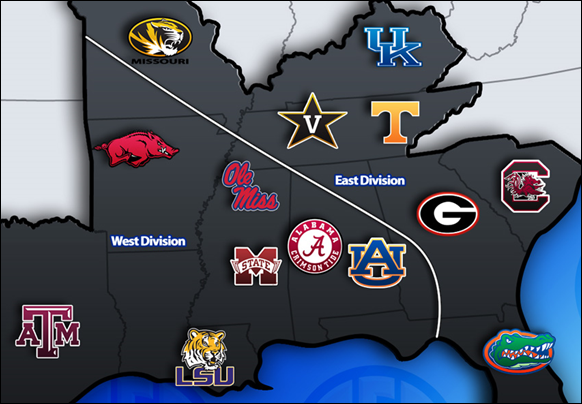
Missouri may not be the ideal fit geographically but it is at least acceptable—the state borders three states with existing conference members in Tennessee, Kentucky and Arkansas. Here’s a map courtesy of Mizzou2SEC.com, a fan website established to promote the addition of the school as the 14th member.

 image

Mizzou also makes sense from a media marketing standpoint—adding the potential to penetrate the St. Louis and Kansas City markets and adding another six million people to the potential media demographic.

Could the SEC “do better?” Perhaps, but only by hunting on posted ground and luring a member of an existing BCS automatic qualifying school. But if we restrict the candidates to only AAU members, it’s hard to make the argument that they’d be doing better. From the ACC, candidates would include Duke, Georgia Tech, Maryland and Virginia. From the Big East, candidates would be limited to Rutgers and Pitt. Which of those six schools are comparable in geography, market potential and demographics?

Duke and Virginia.

I’ll let that sink in a moment.

If the SEC Presidents decide to relax the requirement of AAU membership and poach one of the non-AAU members in the ACC or Big East with more football earnings power, aren’t they guilty of the hypocrisy we smell in Solomon’s column?

Exit Question: Do you really believe the SEC is comfortable with 13 members for any length of time?

Wednesday, October 5, 2011

JASON LIVES: Missouri Board of Curators authorizes conference shopping

image Strongest indication yet that Mizzou will become SEC’s 14th team
We told you last month that this story had the staying power of Jason Voorhees.
In another story from the Kansas City Star’s Mike DeArmond (whose coverage of this story has been the most accurate from the start),  The University of Missouri Board of Curators has authorized Chancellor Brady Deaton to explore conference membership opportunities.
Quashing any rumors that the Board was divided over the issue, DeArmond reports that the vote was unanimous. While interim Big 12 Commissioner Chuck Neinas has been preaching unity and telling reporters that Missouri would remain a member of the conference, Mizzou is telling the world that it’s looking out for the interests of the University.

“The Board of Curators delegates to Chancellor Deaton the authority to take any and all actions necessary to fully explore options for conference affiliation and contracts related thereto which best serve the interests of the University of Missouri-Columbia and the University of Missouri system,” Erdman said
Deaton then announced he had resigned his position as chairman of the Big 12 board of directors to “avoid any perceived or actual conflict of interest” and “in order to focus more fully on MU’s best interests.”
Deaton said he will work with other MU officials “to expeditiously examine what may be the best conference affiliation for our university.”

At issue is a proposal to have the nine remaining Big 12 schools agree to a deal in which all first- and second-tier media revenues would be committed to the league for equal distribution. This would include all revenues from the league’s television contracts with ABC/ESPN (first tier) and Fox Sports (second tier). Texas’ Longhorn Network is a third tier and would not be included. The deal would last for six years, whether the institutions are members of the Big 12, or not. The deal was contingent upon each remaining Big 12 school to agree to the measure and with yesterday’s vote, Missouri told the Big 12 that they were having none of it.
Multiple independent sources in Birmingham and around the league have told IBCR that Missouri could be accepted by the SEC as early as Friday, but that a more likely case was a decision next week. If Missouri applies, they will be accepted. Missouri has not formally applied for membership, nor has the league offered a formal invitation to the school, but the school and league officials have discussed the move in enough detail to allow the Missouri Board of Curators to “feel good” about last night’s decision.
Jason lives, y’all!
UPDATE: The Birmingham News’ Jon Solomon reports that there were no discussions of scheduling in a 14-team league when SEC Athletic Directors met Wednesday.
"We can't talk about it," Florida Athletics Director Jeremy Foley said after the ADs met for about four hours at the SEC office. "We're talking about A&M."
Said Mississippi State Athletics Director Scott Stricklin: "We didn't talk any 14-team schedules. It was all focused on the 13-team model."
Jason lives, but he’s stalking his next victim, or something.

Follow me on Twitter and Facebook.


Friday, September 23, 2011

The Mizzou to SEC story just won’t die

JasonMizzou And we thought Jason Voorhees would never die.

According to a story filed late last night by the Kansas City Star’s Mike DeArmond, Missouri isn’t ready to commit to the Big 12 and still considers a move to the SEC as an option.

At issue is a proposal to have the nine remaining Big 12 schools agree to a deal in which all first- and second-tier media revenues would be committed to the league for equal distribution. This would include all revenues from the league’s television contracts with ABC/ESPN (first tier) and Fox Sports (second tier). Texas’ Longhorn Network is a third tier and would not be included. The deal would last for six years, whether the institutions are members of the Big 12, or not.

That means your TV revenues belong to the conference even after you decide that Texas’ behavior is simply too toxic and you decide to abandon ship for a better conference.

The last two years have been a bloodbath for the Big 12, with Nebraska bolting to the Big 10 and Colorado joining the Pac-12 last year, Texas A&M leaving for the Southeastern Conference for next season, and Commissioner Dan Beebe losing his job over the instability and uncertainty regarding the future of the conference.

Reports of an agreement having been reached yesterday led to many observers believing that the conference realignment carousel had finally stopped spinning and that the Mizzou move to the SEC was dead. Not so fast, says the Voorhesian Tiger program. There are several quotes in DeArmond’s report that should raise some eye brows:


“We either stick in the Big 12 because everything came about the way it needs to, the right way, with all the differences being settled in Missouri’s favor,” a university administrator who asked not to be identified told The Star on Thursday night. “But what are the odds of that happening?

“The other option is to join another conference and I believe that is something that we’re very open to.”

When asked about the SEC, Deaton said that was another hypothetical and he wouldn’t elaborate further.

Asked if the SEC was still in play, the administrator, who contacted The Star, said: “You will not look stupid by insinuating that.”

Asked again if Deaton was prepared to make a statement that Missouri would remain in the Big 12 for the foreseeable future, Deaton said:

“The University of Missouri is going to continue to work for what is best for the University of Missouri.

“We have seen that aligned with the Big 12 Conference.”

The Missouri administrator who asked not to be identified told The Star that Deaton’s statement should be construed as less than an unconditional commitment to the Big 12 at this time.


A lot of people are taking heat over their reporting in the conference realignment shuffle. It’s a lot like a national coaching search at a top-tier university, where many big-name candidates are in play, each with varying and shifting degrees of interest in the program and vice versa. What is true at the time it’s reported may not be true less than one rotation of the earth later, and things no one had on their radar screens are suddenly on your six and getting a weapons lock.

In this blogger’s opinion, the only two ways this all comes to an end is if the Big 12 completely disintegrates and its former members drift off into new alliances, or Texas comes to its “good of the whole” senses and agrees to share a significant portion of the LHN revenues with the league and agrees to restrictions on how it uses it for recruiting.

Until one of those two things take place, Jason lives.

Follow me on Twitter and Facebook.

Tuesday, September 20, 2011

What should divisions look like with a 14-team SEC? Easy…

image Today, the Kansas City Star cited reliable sources in a report that Missouri had an offer on the table to join the SEC, and that the SEC was willing to wait on the final fate of the Big 12 conference. The boards of regents at Oklahoma and Texas have both voted to explore options, and of course all of this comes in the wake of Texas A&M’s formal secession from the Big 12 and acceptance into the SEC (barring court action blocking the move).

Later reports from USA Today’s Campus Corner had the SEC denying that it had made an offer to Missouri, but the sense is that the “denial” is plausible because, while the SEC probably has a wink-nudge offer to Mizzou, no way is Slive & Co. going to allow themselves to be portrayed as hunting on posted ground.

A&M looks to be all but a done deal and Mizzou might well be the dance partner, bringing the SEC to a 14-program conference with two, seven-member divisions.

The math of having an even number of conference participants makes scheduling a relatively easy thing to do. Scheduling equitably with 13 members is doable, but it wouldn’t be easy and it would leave some division members missing out on one game that they’d probably like to play.

There’s a good deal of chatter on how the two new conference members would fit into the league’s divisional system. Some folks think having two programs from west of the Mississippi all but guarantees that Auburn is pushed into the SEC East and both of the former Big 12 schools join the west. There’s also talk of rearranging some of the programs from the East and West to bring more balance. All of that is much too complicated and would likely end some storied conference rivalries.

A much easier solution (and therefore the one that will likely be the first option rejected) would be to simply rename the two divisions, keep the existing members in place and split the two new programs between the former East and West Divisions. Like this, for example:

Former SEC West Former SEC East
Alabama Florida
Arkansas Georgia
Auburn Kentucky
LSU South Carolina
Miss State Tennessee
Missouri Texas A&M
Ole Miss Vanderbilt

In order to maintain the eight-game SEC schedule that requires each team to play each of its divisional opponents, one of the two rotating interdivisional games would have to be dropped, and each member school plays two opponents from the other division, rather than three (a recent schedule tweak following the addition of the 12th regular season game). One of the two interdivisional opponents is designated a divisional rival, while the other rotates on a home-away basis.

Alabama keeps its Iron Bowl rivalry with Auburn and neither team faces the prospect of having to play back-to-back should both be in the SEC Championship Game. Tennessee and Alabama also keep their storied rivalry, as do Auburn and Georgia, Tennessee and Florida, Georgia and Florida, and so on. Texas A&M and Missouri would almost certainly choose one another as their interdivisional rival, and you’re all set for an eight game schedule with 14 teams in the SEC.

Told ya that would be easy. Check, please?

Exit Question: Can Mike Slive avoid the disaster of division names that Jim Delany came up with?

Follow me on Twitter and Facebook.