Showing posts with label Conference Expansion. Show all posts

Tuesday, March 6, 2012

Might the SEC tweak the division rotation system to maintain permanent rivalries?

image Over at sbnation.com’s TeamSpeedKills, Year2 has an interesting post on how to tweak the rotation of interdivision games in an eight-game schedule. It both maintains the permanent rivalry games between Alabama and Tennessee and Georgia and Auburn and allows for all of the league’s programs to meet at least once over a six to seven year period.

Maintaining the storied rivalries within the league has to be a priority for decision-makers because these are the matchups that form the very fabric of the league’s appeal. They seem to be getting it—both Year2’s post and a report earlier this week noting comments from South Carolina’s Harris Pastides show strong support within the league for keeping these marquee matchups.

There are two ways of doing this: installing a nine-game schedule to accommodate a better rotation between the two divisions—a possibility that people could probably accept as a reasonable tradeoff—or getting creative with the rotation scheme, like Year2 does.

Let’s take a look:


This is something I've thought about before, so here's an example rotation I made a while ago using Alabama. I picked the Crimson Tide because its first alphabetically, and the rotating East teams go through alphabetically as well. For the second half, teams have to get moved around in order to switch the home/road arrangements.

Year 1: Florida, at Tennessee

Year 2: at Georgia, Tennessee

Year 3: Kentucky, at Tennessee

Year 4: at Missouri, Tennessee

Year 5: South Carolina, at Tennessee

Year 6: at Vanderbilt, Tennessee

Year 7: Georgia, at Tennessee

Year 8: at Florida, Tennessee

Year 9: Missouri, at Tennessee

Year 10: at Kentucky, Tennessee

Year 11: Vanderbilt, at Tennessee

Year 12: at South Carolina, Tennessee

With this system, a fifth-year senior would face 12 of a possible 13 SEC schools before his time is up. It would also make sure that every team plays each other conference opponent at least once every six or seven years, which is a lot better than the alternative of needing 12 years to complete an entire rotation.


The nine game schedule has three important benefits for the league. One, it ensures that interdivisional rivalries are kept alive, and it allows Georgia, Florida, Kentucky and South Carolina to keep their non-conference rivalries alive. Two, it doesn’t force programs to choose between the rivalry game and a non-conference patsy game for bowl eligibility purposes. Three, it creates a better conference game inventory and more media revenue for the league. But it reduces opportunities to schedule other big non-conference opponents, like the 2011 LSU vs. Oregon game and 2012 Alabama vs. Michigan matchup. It also creates heartburn by coaches and administrators who worry about adding another conference game, seven more losses league-wide and unbalanced home-away conference schedules.

The eight game schedule alleviates the latter concerns. With a creative rotation scheme like the one above, the permanent rivalries are maintained and there’s still enough room in the non-conference schedule to permit the East’s non-conference rivalries and the big time matchups we’ve had the last several years. It doesn’t create as many conference matchups as the media partners would like, but it does create more than the current 6-1-1 rotation over the 12 year period.

Year2 goes on to confidently predict that the league will ultimately settle on the eight game slate with a rotation similar to what he’s described. The mix hasn’t even started hardening yet, and don’t count out the influence of what the powers-that-be decide to do with the postseason. But I wouldn’t bet against the creative eight game schedule.

Notice also that the scheduling decisions made by other leagues don’t enter into this discussion at all. The fact that other conferences are going to or are considering nine game schedules has zero influence on the SEC’s deliberations. All of the cultural, political, traditional and financial considerations are unique to the SEC. What the other cool kids are doing is totally irrelevant.

Follow me on Twitter and Facebook.

Saturday, March 3, 2012

A nine game schedule may be a necessary tradeoff for the SEC

image When the Southeastern Conference added Missouri and Texas A&M to college football’s premier conference, one of the first issues it had to address was scheduling. In the process of developing the 2012 conference schedule, the problem of maintaining interdivisional and non-conference rivalries in an eight game schedule really came to a head.

The one thing that should never be lost are the traditional rivalries in the league. Alabama vs. Tennessee and Auburn vs. Georgia are two of the premier games of the season. These are cherished rivalry games that put the league’s storied tradition on display every year and no scheduling scheme should ever eliminate them.

In addition, Florida, Georgia, Kentucky and South Carolina have traditional non-conference rivalries with Florida State, Georgia Tech, Louisville and Clemson, and those should also be placed at the top of the list of priorities for scheduling.

Maintaining traditional rivalries while also giving fans and media partners a better inventory of football games can be done, but not with the 6-1-1 format of playing all divisional opponents, one permanent interdivisional rivalry opponent and a rotating interdivisional opponent each year. That format blunts the impact of adding the two new programs.

So the cost of growth should come at the expense of the eight-game schedule. It should not come at the expense of ending storied rivalries.

As many others have pointed out—and as this blog explained last October—the nine game schedule causes a lot of indigestion on the part of administrators and coaches. Adding another SEC game causes heartburn for the coaches, and administrators don’t like the idea of giving up an SEC home game every other year. Both objections are understandable. Coaches get paid to win games and adding a ninth game makes that more challenging. Administrators get paid to deliver revenue and nothing pays the bills like home games.

But maintaining the marquee games in the league is of paramount importance. They are the showcases of the league and continue the cherished traditions that have made the SEC the country’s premier conference. There is absolutely nothing in college football that’s better than the atmosphere leading up to and surrounding these matchups. They are circled on millions of calendars across the south. They are looked forward to with such anticipation that the thought of eliminating them would never even cross the minds of the fans and the players, both current and former.

Ask Barry Krause what the Third Saturday in October means to him. Ask Herschel Walker what the Deep South’s Oldest Rivalry means to him. Ask any Bama or Auburn season ticket holder what he thinks. It’s a no-brainer.

Maintaining that thread to the past is so important, it’s worth the tradeoff of a ninth league game, and it may well be the only way to do so.

Follow me on Twitter and Facebook.

Wednesday, January 25, 2012

The 2012 Conference Realignment Season in full swing!

image Remember how much fun the 2011 Conference Realignment Season was?

The Big 12, the SEC, the Big East, even Conference Jambalaya were reshuffled to one extent or another during a months-long ride on a dizzying carousel. It broke longstanding regional bonds, ended traditional rivalries and tested the trust of conference commissioners, university presidents and fans.

The 2012 season is just beginning.

Yesterday, Navy and the Big East announced that the service academy would end its status as an independent and join the conference beginning in 2015 for football only.

And in another development, the Chronicle of Higher Education’s Brad Wolverton reports that sources say that the Big 12 will also reopen conference expansion talks, with the possibility of expanding back to 12 members on the table.

Wolverton was told that possible candidates for admission are Louisville, a Big 12 candidate last year, and current independent Brigham Young.


Further Big 12 expansion is “very possible,” two high-ranking sources told The Chronicle. An expansion committee, dormant for months after the conference accepted West Virginia and TCU into league play, will meet today to discuss its options.

While conference officials stressed that no decision is imminent–and there is some opposition to moving beyond the current 10 member institutions–two schools are at the top of the list, should the league make a move.

Louisville, which the Big 12 considered adding last year, is the likeliest choice, according to people with knowledge of the talks. And Brigham Young, another university the conference has considered, continues to be a possible target. One official said the league was open to adding just one institution. “The Big Ten made 11 work for a number of years,” the source told The Chronicle.


Geography played only a backup role in the 2011 round of reshuffling. It’s a coin flip as to whether commissioners and university officials incorporate that novel concept in 2012.

It’s also worth noting that the conference commissioners have already met once to discuss the future of the BCS, with more meetings to be held in the months ahead. Ironically, the BCS’ system of automatic qualification for the five major conferences is on the table at the same time that AQ status is driving conference realignment.

The period between spring drills and fall camp is normally a very quiet time for college football enthusiasts. That all changed with the 2011 season and it looks like the 2012 season will be just as interesting and just as unpredictable.

Follow me on Twitter and Facebook.

Thursday, October 6, 2011

Hypocrisy on display by SEC Presidents?

image Either the Birmingham News’ Jon Solomon’s sources are misleading him, or the Southeastern Conference Presidents are displaying a sickening degree of hypocrisy by suggesting that the league can “do better” than adding Missouri.

The current Big 12 Missouri Tigers’ Board of Curators voted late Tuesday to authorize Chancellor Brady Deaton to explore conference membership options.

According to the sources cited in Solomon’s column, Missouri enjoys majority support for a bid to join the SEC, but that support falls short of the nine votes needed. My own information differs only slightly from what Solomon was told—that Mizzou would be welcome in the league so long as the 14-team divisional alignment preserves the traditional rivalries of Alabama vs. Auburn, Alabama vs. Tennessee, Auburn vs. Georgia, Georgia vs. Florida, etc. This would mean placing Texas A&M and Missouri (or whoever the potential 14th member is) in separate divisions and leaving the remaining conference members in their respective divisions. This, I am told, is the position of the University of Alabama and others as well. If adding Missouri means pushing Auburn or some other SEC West school into the East division, support in the league falls and not only would it be short of the three-fourth’s majority, getting even a simple majority would be a coin flip.

The conference isn’t putting a Mizzou application to a vote of the Presidents unless somebody has counted the votes and they know it will pass.

But the notion that the league can “do better” than Missouri just reeks with hypocrisy. Currently, the league has only two members of the prestigious Association of American Universities—Florida and Vanderbilt. The addition of Texas A&M brings that to three, and Missouri would make it four. If academics count for something in consideration of conference expansion, how do you do better than adding an AAU member?

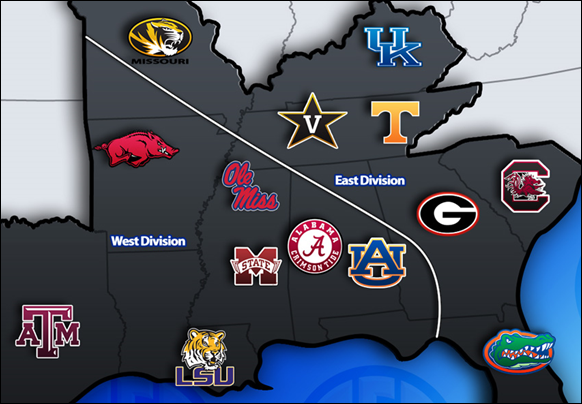
Missouri may not be the ideal fit geographically but it is at least acceptable—the state borders three states with existing conference members in Tennessee, Kentucky and Arkansas. Here’s a map courtesy of Mizzou2SEC.com, a fan website established to promote the addition of the school as the 14th member.

 image

Mizzou also makes sense from a media marketing standpoint—adding the potential to penetrate the St. Louis and Kansas City markets and adding another six million people to the potential media demographic.

Could the SEC “do better?” Perhaps, but only by hunting on posted ground and luring a member of an existing BCS automatic qualifying school. But if we restrict the candidates to only AAU members, it’s hard to make the argument that they’d be doing better. From the ACC, candidates would include Duke, Georgia Tech, Maryland and Virginia. From the Big East, candidates would be limited to Rutgers and Pitt. Which of those six schools are comparable in geography, market potential and demographics?

Duke and Virginia.

I’ll let that sink in a moment.

If the SEC Presidents decide to relax the requirement of AAU membership and poach one of the non-AAU members in the ACC or Big East with more football earnings power, aren’t they guilty of the hypocrisy we smell in Solomon’s column?

Exit Question: Do you really believe the SEC is comfortable with 13 members for any length of time?

Tuesday, September 20, 2011

Conference Realignment and Notre Dame: No white smoke

image Yahoo! Sports’ Dan Wetzel penned a column yesterday, laying out a sound case for Notre Dame giving up its football independence and aligning with a conference that he believes is the best fit—the ACC. It’s a compelling case.

“Ask people in South Bend and one of their chief concerns about super-conferences is whether they will prevent the Irish from putting together legitimate 12-game schedules, including revenue-rich seven or eight home games. Then it’s what it might do to basketball and other sports,” writes Wetzel.

He also points out the demographic trends of the Midwest region of the US, which is growing much more slowly than the Southeast and the Atlantic seaboard, and how population patterns play important roles in both audience and recruiting. When fewer people are living in your region, you have fewer eyes glued to your broadcasts and fewer people in your recruiting territory.

Those are good points, but I don’t see any white smoke from the chimney.

Notre Dame’s “recruiting territory” is the United States of America. It has significant fanbase representation in virtually every major media market in the country. It has its own television contract with NBC Sports. It has longstanding rivalries with Southern Cal, Michigan, Michigan State, Pitt, Purdue, Boston College and the military service academies. Super-conferences with 16 members each will still likely have either eight or nine game schedules that may preclude Notre Dame from maintaining all of those rivalries, but it’s doubtful that we’d see the end of the USC – Notre Dame or Boston College – Notre Dame or Navy – Notre Dame rivalries.

By remaining independent, would the school face the challenge Wetzel identifies in putting together the schedule? Sure. But things can get worked out. Taking the path of least resistance and succumbing to the ACC would be the end of the Irish mystique. It would relegate it to the same status as a Florida State or Virginia Tech. I think the ACC likes Notre Dame a lot more than Notre Dame likes the conference. Any conference, for that matter.

Joining a conference other than the Big 10 likely ends one or more of the rivalries with Michigan, Michigan State and Purdue. Why would the Irish give up such nationally seismic matchups like that for a schedule that includes Clemson and NC State, especially when either the Boston College or the Pitt series could still likely be maintained? If they were forced to give up the biannual trip to Los Angeles, they lose access to a hotbed of recruits in the nation’s most populous state and trade that for a conference matchup with Duke? Notre Dame has access to the east coast also, due its storied rivalries with Army and Navy, two of the greatest places on the face of the earth to watch a college football game. I just don’t see any of that happening.

The conference realignment craze is driven by money, media influence and market share. Notre Dame has a multibillion dollar endowment and ample revenues from its TV deal. It really doesn’t need the money and it already wields considerable influence in the world of college football. They haven’t been in a national title chance since before many of you were even born, but the school still commands ratings and fills the stadium every Saturday.

Notre Dame may feel a little pressure to join the realignment bandwagon, but at the end of the day, their national recruiting territory, national mystique and storied rivalries will live on, as will their FBS independence. Short of a Papal Bull, that is, and fumata bianca billowing from the chimney atop the Basilica of the Sacred Heart.

Follow me on Twitter and Facebook.

Tuesday, September 13, 2011

With the Big 12 “done,” this was just bound to happen

Sources tell the Austin-American Statesman that Texas officials traveled to Norman, OK this week to try salvaging the sinking Big 12 Conference. However, those sources say Oklahoma and likely Oklahoma State are looking for exits, with a possible destination of the Pac 12.

“The Big 12 is done,” according to the paper’s source.

With that being the case, we did a quick scan of Ebay and what do we have here?!?


Click the image for the full resolution view.

If you use this, please give proper credit to www.ibleedcrimsonred.com and link back to the site, please.
Meanwhile, follow me on Twitter and Facebook.

Wednesday, September 7, 2011

Welcome to the SEC, Texas A&M

image Overnight buzz was that the Southeastern Conference had met and unanimously approved the admission of Texas A&M University as the league’s 13th member, but various news reports indicate that one (possibly more) Big 12 school was still considering legal action.

While I don’t necessarily doubt those reporters’ sources, I don’t think the SEC would hold such a meeting, take such a vote, and release a statement on the matter if it didn’t have firm assurances that no legal action from Baylor (et al) was forthcoming.

Here’s the statement from Florida’s Bernie Machen, chair of the league’s chancellors and presidents board:


After receiving unanimous written assurance from the Big 12 on September 2 that the Southeastern Conference was free to accept Texas A&M to join as a new member, the presidents and chancellors of the SEC met last night with the intention of accepting the application of Texas A&M to be the newest member of the SEC. We were notified yesterday afternoon that at least one Big 12 institution had withdrawn its previous consent and was considering legal action. The SEC has stated that to consider an institution for membership, there must be no contractual hindrances to its departure. The SEC voted unanimously to accept Texas A&M University as a member upon receiving acceptable reconfirmation that the Big 12 and its members have reaffirmed the letter dated September 2, 2011.


Some are reading this statement to mean that there may still be a legal hurdle to overcome, and that the SEC isn’t being very business savvy by playing their cards this way. This is not how I understand what’s being communicated here.

Read the last sentence again:

“The SEC voted unanimously to accept Texas A&M University as a member upon receiving acceptable reconfirmation that the Big 12 and its members have reaffirmed the letter dated September 2, 2011.”

Upon receiving written notice that none of the Big 12 schools would stand in the way of Texas A&M leaving their conference and joining the SEC, the latter met and finalized the move. Upon hearing that at least one school in the Big 12 was reconsidering, Slive’s people contacted Beebe’s people and got the all clear—that Baylor (or whoever) had decided not to let the matter be decided by a judge and cleared the way.

That resulted in this morning’s statement, and it indicates to me that the deal is done.

Welcome to the Southeastern Conference, ladies and gentlemen. Tighten your chinstraps.

Follow me on Twitter and Facebook.